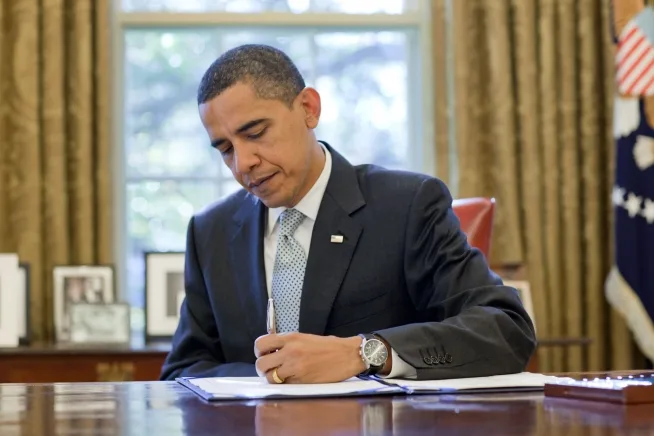
A bill signed by the president can remain a dead letter for years if no budget appropriation is voted to implement it.
Official publication, codification, the drafting of implementing regulations, the allocation of funds and any legal challenges also weigh on the real effect of the text.
After the signature: what still blocks application
Once the text is signed by the president, or adopted after an overturned veto, it receives a public law number. The measure's entry into force can still take months.
First, the text must be published in the Statutes at Large, the official compilation of laws passed by Congress. This publication is authoritative in the event of a dispute, but it is not always immediate. Next, the law must be integrated into the United States Code, a thematic compilation that can take months. If the law amends an existing provision, the Code's editors must rewrite the sections concerned, which can introduce transcription errors.
Most major laws provide that federal agencies draft implementing rules. These rules specify the technical details: forms, thresholds, deadlines, review procedures. The drafting of these texts goes through the rulemaking process, with publication of a notice in the Federal Register, a public comment period, then publication of the final rule. The delay depends on the agency's workload and on the number of comments filed. If the agency lacks the staff or the budget to produce these rules, the law stays unapplied.
A law can also require new spending without Congress having voted the corresponding appropriations. Aid programs, grants and new agencies fall into this category. The legislative text authorizes the program, but the appropriations committee must then allocate the money. Without that allocation, the program does not start. Finally, a law can be challenged in court. A judge can suspend its application pending a review on the merits, which delays the effect further.
A grant program for solar panels illustrates the sequence. The text signed in January provides that applications can be filed from July. But the energy agency must first publish a regulation defining the eligibility criteria. That regulation is proposed in March, commented on in April, finalized in June. Without appropriations voted before October, no check is issued before the following year.
The final text sits on Congress's website, the proposed regulations in the Federal Register, the appropriations in budget reports and court decisions in public databases.
Why so many bills die before the vote
Before reaching the signature, a text must survive a series of obstacles that eliminate the vast majority of proposals introduced. According to a UNJF course, the president does not have the right to initiate laws, in the name of a rigid conception of the separation of powers. Any text must therefore be introduced by a member of Congress.

Drafting and framing errors
A text that contradicts the Constitution, or whose wording leaves two readings open, can be rejected as early as the committee review. Parliamentary staff spend weeks negotiating the language, consulting experts and checking compatibility with existing laws. A proposal that skips these checks risks being torn apart in a public hearing, and other members then keep their distance.
The absence of strategic support
An initiative without an influential sponsor or a coalition of interest groups has little chance of getting a hearing. The chair of the relevant committee decides which texts will be examined. If the proposal is not on the agenda, it stays in a drawer, sometimes for the entire legislature. Lobbyists and civil society organizations push files onto that agenda through meetings with committee staff.
Amendments that distort the text
In committee as well as on the floor, amendments can transform a proposal to the point that its original authors no longer recognize it. Some amendments carry a controversial provision meant to sink the whole bill: opponents count on the majority rejecting it. Other amendments add tax gifts or exceptions that make the text unacceptable to the other chamber.
The calendar and the procedure
In the US Senate, the filibuster rule allows a single senator to block a vote by speaking without limit. Cloture requires 60 votes. Bills passed in the House of Representatives therefore often never reach a Senate vote. Parliamentary sessions also have a fixed length: a proposal not adopted before the end of the session expires and must be reintroduced.
What not to do if you want an initiative to succeed
- Do not draft a text without checking its constitutionality and its budget impact.
- Do not file a proposal without having identified a committee chair ready to schedule it.
- Do not neglect writing a clear summary and briefing documents for other lawmakers.
- Do not underestimate the importance of pressure groups that can mobilize voters.
- Do not offer amendments without having negotiated beforehand with the party leaders.
- Do not count on a Senate vote if you do not have 60 votes to overcome a possible filibuster.
What citizens should not do when following a bill
- Do not trust the catchy title of the proposal: read the full text.
- Do not assume that the president's signature means immediate implementation.
- Do not overlook committee reports, which explain the real intentions.
- Do not believe that a floor vote is the last word, because the Senate can still change everything.
- Do not lose sight of the budget question: a law without appropriations funds nothing.
- Do not consider a dead initiative pointless: the same text can be reintroduced in the next session.
The official path, step by step
- Filing of the bill. A member of Congress files the proposal with the office of the clerk (House) or the secretary (Senate). The text receives a number (H.R. for the House, S. for the Senate). The full text is published on the official Congress website.
- Referral to committee. The proposal is referred to the committee with jurisdiction over its subject. The committee may refer it to a subcommittee for detailed review. Public hearings allow experts and stakeholders to be heard. The committee may decide to do nothing, in which case the text dies quietly.
- Committee consideration. The committee examines the text section by section, proposes amendments and votes. If the committee adopts the text, it produces a written report explaining the intent and impact. Courts and agencies later rely on that report when a provision is contested.
- Scheduling for the floor. The text is placed on the agenda by the chamber's leaders. In the House of Representatives, the Rules Committee sets the terms of debate: duration, admissible amendments, and so on. In the Senate, unanimous agreement is often needed to set the terms, which gives each senator a blocking power.
- Debate and vote in the chamber of origin. Members debate, propose amendments, then vote. A simple majority is enough to adopt the text (218 votes in the House if all seats are filled, 51 in the Senate unless there is a filibuster). The Senate can still refuse to take up the bill.
- Consideration by the other chamber. The text is sent to the other chamber, which follows the same process. If the second chamber adopts the text without changes, it is sent to the president. If it adopts a different version, the two chambers must reconcile their versions, often through a conference committee.
- Conference committee. A joint committee brings together members of both chambers to negotiate a common text. The conference report must be voted on by each chamber without new amendments. Provisions refused on one side are dropped from the final report.
- Transmission to the president. The final text is sent to the White House. The president has ten days (excluding Sundays) to sign it, veto it, or let it become law without a signature. If the president vetoes it, Congress can override the veto by a two-thirds majority vote in each chamber.
The invisible players who shape the law
Congressional staff and lobbyists
Every member of Congress has a staff of aides who draft bills, negotiate with other offices and prepare amendments. Lobbyists, often former staffers, bring technical expertise and access to decision-makers. Committee reports and hearing transcripts often reproduce their proposed language word for word.
Implementing agencies
Federal agencies write the rules that give the law its substance. Their interpretation can widen or narrow the scope of the text. Citizens can comment on proposed regulations, provided they file within the comment window and follow the format set in the Federal Register notice.
Appropriations committees
A bill can authorize the creation of an agency, but if the appropriations committee allocates no budget funding to it, it will have neither premises nor employees. Authorization and appropriations are handled by separate committees, on separate calendars.
The courts
Federal judges can strike down a law if it violates the Constitution. They can also suspend its application pending a final ruling. Agencies then delay hiring and contracts for programs that risk being cancelled.
Committee reports, rulemaking notices, budget documents and court decisions are all public. The full text, amendments, committee reports and roll-call votes are available online on official congressional portals.
Tracking a bill like a pro: checklist
- Identify the bill number (H.R. or S.) and save it in a tracking file.
- Read the full text, not just the summary. The summary is written by staff and can lag behind the amended version.
- Download the committee report that accompanies the adopted text. It records the legislator's intent, which courts cite when a provision is ambiguous.
- Follow the amendments filed on the floor. An amendment can radically change the scope of the text.
- Check the projected schedule: dates for debate, vote, and possible cloture in the Senate.
- Consult the official Congress website for roll-call votes. A narrow margin means the majority can flip on the next amendment.
- After adoption by both chambers, read the conference report to spot the compromises.
- If the president signs the law, note the public law number and the publication date in the Statutes at Large.
- Look for the implementing rules proposed by agencies in the Federal Register. Comment on them if you are concerned.
- Check whether appropriations have been voted to fund the programs created by the law.
- Monitor legal challenges that could suspend application.
Further reading
The UNJF course explains that the president has no power to initiate legislation, in the name of a rigid conception of separation of powers.