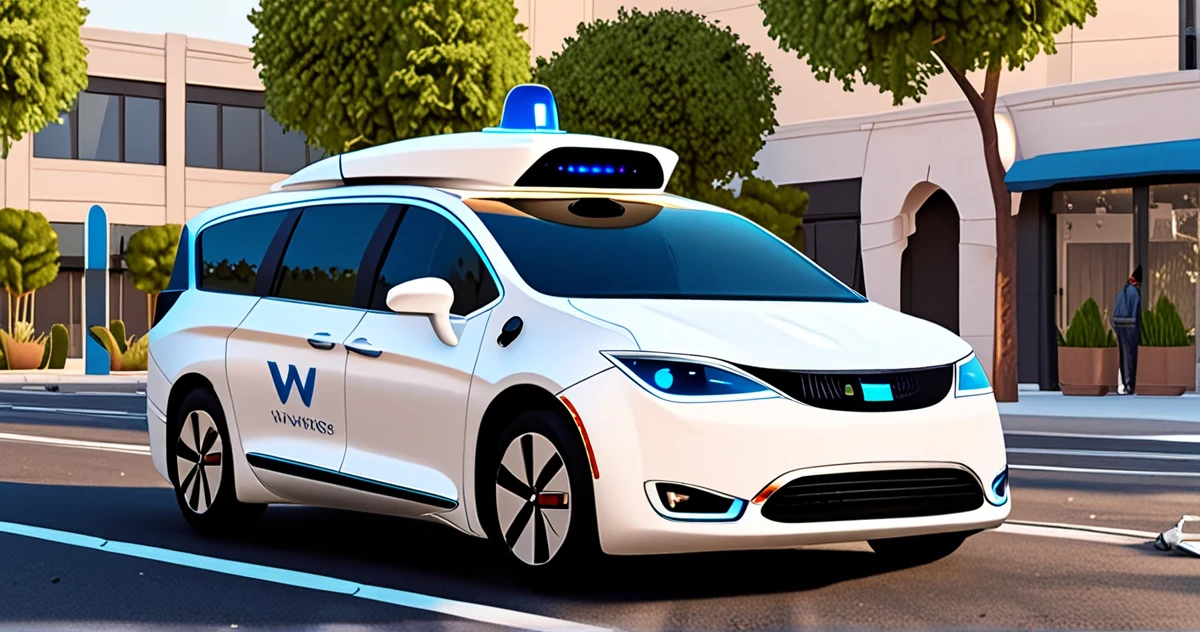
Imagine a vehicle capable of reacting in milliseconds to a car abruptly merging in front of it, while simultaneously planning an optimal route over several kilometers. This duality between immediate reaction and strategic planning is at the heart of the fifth generation of the "Waymo Driver," an architecture that embodies a radically different vision of autonomy, in direct opposition to the "all-in-one" approach of other players like Tesla.
While public debate often focuses on the simple presence or absence of a steering wheel, the real battle for Level 5 autonomous driving is being waged in the deep layers of AI and data fusion. Waymo, with its fifth generation, is not offering a simple software update, but a complete architectural overhaul. This article deconstructs this platform to reveal how it works, why its modular design is a deliberate strategic choice, and what lessons tech professionals can draw from it for designing complex and safe robotic systems.
The DNA of a Robotic Driver: A Dual-Speed Architecture
The cornerstone of the fifth generation of the Waymo Driver is its architecture designed to handle two radically different time scales. As a detailed analysis of its operation explains, this architecture "splits the difference" into two distinct but interconnected systems.
- The Fast System (System 1): This is a sensor fusion encoder that operates in a closed loop, reacting within a few milliseconds to unexpected road events – a pedestrian jaywalking, a vehicle cutting in. This system is optimized for extremely low latency and reliability, relying on real-time fusion of LiDAR, radar, and camera data.
- The Slow System (System 2): This is the strategic planner. It operates over a longer time window, evaluating scenarios, calculating optimal trajectories, and managing complex interactions with other road users. This is where algorithms for predicting the intentions of other vehicles and pedestrians come into play.
This separation is not an accident. It is the result of a design philosophy that prioritizes robustness and safety in the face of the unpredictable. Unlike a monolithic approach where a single neural network tries to do everything, this modularity allows for isolating failures and optimizing each subsystem for its specific task.
Sensor Fusion: More Than Redundancy, a Layer of Certainty
Waymo has always bet on a rich and redundant sensor suite: LiDAR, radar, high-resolution cameras. With the 5th generation, this fusion reaches a new level of sophistication. It is not simply about overlaying images, but about creating a unified and dynamic 3D representation of the environment – a "living map" that updates several times per second.
Key takeaways from Waymo's approach:
- Redundancy is a safety function, not a luxury. Each type of sensor compensates for the weaknesses of the others (LiDAR for 3D precision in all weather, cameras for semantics and color, radar for speed and in fog).
- Fusion occurs early in the processing chain. Raw sensor data is combined before being interpreted, enabling the construction of a more reliable and artifact-resistant perception.
What not to do (a lesson drawn from comparisons with other approaches): Do not consider perception as a purely visual problem solved by cameras alone. Underestimating the importance of direct distance measurement (telemetry) in varied real-world conditions is a major risk to operational safety.
Prediction Algorithms: Anticipating the Human
The most complex part of autonomous driving is not following a line, but predicting the behavior of others. Technical documentation on Waymo's AI architecture highlights innovative improvements in this area. The system does not merely detect a pedestrian at the curb; it assesses their potential trajectory, their intention (are they looking at their phone? looking for a crossing?), and integrates this probabilistic prediction into the planning of its own trajectory.
These prediction models are fueled by petabytes of data collected during millions of kilometers driven in real-world conditions. They learn the "patterns" of human behavior in dense urban contexts, allowing the vehicle to react in a more natural and predictable manner for other road users.
Modularity vs. Monolithic: The Great Architectural Debate
To understand the relevance of Waymo's design, one must contrast it with the opposing approach, embodied by Tesla. While Tesla pursues an "end-to-end" vision where a single huge neural network processes camera images to directly command the actuators, Waymo has chosen a modular and explicit architecture.
Why this choice is crucial for engineers and decision-makers:
- Debugging and Safety: In a modular system, it is possible to isolate a problem. A prediction failure can be analyzed separately from a perception problem. In a monolithic system, the error is buried in millions of parameters, making certification and safety assurance extremely difficult.
- Scalability and Updates: Improving the sensor fusion module does not require retraining the entire planning network. This allows for faster and more targeted iterations.
- Explainability: It is easier to explain why the vehicle made a decision ("the prediction module assigned an 85% probability that the cyclist would turn left") than in a neural black box.
Waymo's approach, as summarized in a technical document, "exemplifies a robust modular design for autonomous driving." It is a bet on maturity, safety, and the ability to scale a commercial robotaxi service, rather than on pure algorithmic elegance.
Practical Implications Beyond the Road
The architecture of the Waymo Driver Gen 5 is not just a lesson in automotive engineering. It offers a valuable framework for any designer of a complex autonomous system, whether it be logistics robots, delivery drones, or industrial machines.
- Design with failure in mind. Sensor redundancy and modularity are insurance against the inevitable. Do not build a critical system that depends on a single viewpoint or a single algorithm.
- Separate temporal concerns. Systems that must react in real-time and those that plan long-term have different optimization constraints. Their loose coupling in a well-defined architecture is a source of robustness.
- Prediction is the new perception. To interact safely in a dynamic and populated environment, simple object detection is insufficient. Investment must be made in models capable of anticipating intentions.
Conclusion: A Roadmap for Responsible Autonomy
The fifth generation of the Waymo Driver is much more than a set of more powerful sensors. It is the hardware and software expression of a philosophy: that of an autonomy built brick by brick, with safety and reliability as unshakable foundations. By opposing a modular and redundant architecture to the monolithic "end-to-end" vision, Waymo charts an alternative path towards Level 5 – a path perhaps less media-friendly, but resolutely pragmatic.
For the industry, the message is clear: the race for autonomy will not be won solely with the largest AI model or the biggest chip. It will be won with the design of resilient systems, whose behavior can be understood and audited. As regulators begin to seriously consider the certification of these technologies, Waymo's architectural approach could well become the benchmark for demonstrating safety. The question is no longer just whether a car can drive itself, but how it does it – and according to what logic we can trust it.
To Go Further
- Thinkautonomous.ai - Comparative analysis of Tesla and Waymo's visions and architectures for autonomous driving.
- Medium - The Low End Disruptor - Article detailing the dual-speed architecture (System 1 / System 2) of autonomous systems.
- Techrxiv - Technical deep dive into Waymo's AI and robotic architecture, including prediction enhancements.
- ScienceDirect - Overview of the AI revolution in industries, mentioning Waymo's autonomous technology.
- Wikipedia - Definition and general context on self-driving cars.