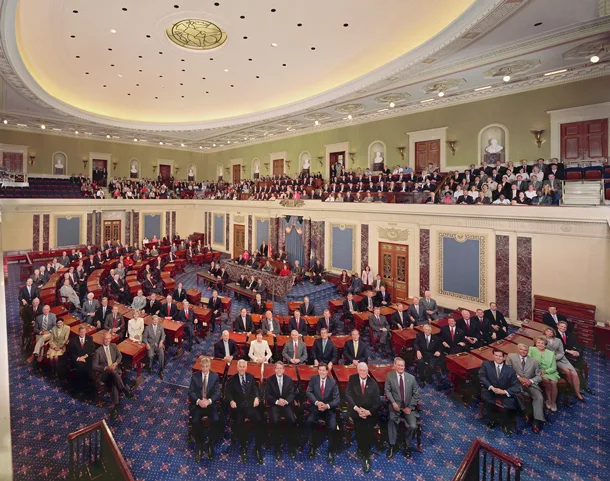
In January 2022, all 50 Democratic senators expressed support for federal voting rights reforms. Yet none of those reforms were adopted. The reason was neither a lack of political will nor majority opposition, but a procedural rule more than a century old: the filibuster. According to PBS, the 50 Democrats agreed on the need to protect access to voting, but the 60-vote threshold required to end debate left their majority powerless.
This blockage illustrates a broader problem: the U.S. Senate, intended as a chamber of deliberation, has become the place where a minority can systematically prevent the adoption of laws supported by the majority. The debate over filibuster reform is therefore not a procedural quarrel; it engages the very capacity of the federal government to respond to contemporary crises, from voting rights to climate change to health care.
> Key points
> - The filibuster requires 60 votes to end debate, giving a minority of 41 senators a veto right over most laws.
> - Historically used to block civil rights, it is today an almost systematic blocking tool.
> - Filibuster reform is at the heart of debates on voting, health care and climate, because it conditions any major legislative action.
> - Several approaches exist: abolition, a reduced threshold, or a return to the "talking filibuster."
An accidental legacy: how the 60-vote rule became a blocking weapon
The filibuster is not written into the U.S. Constitution. It is the product of an accidental procedural evolution. In 1806, the Senate eliminated the motion for the "previous question," which allowed debate to be brought to an end. From then on, senators could speak without limit to delay a vote. It took until 1917 for the Senate to adopt a cloture rule, after a group of senators had blocked a bill on World War I for 23 days. That rule then required a two-thirds majority, reduced to 60 votes in 1975.
The Brennan Center for Justice recalls that this procedure was "long used by Senate minorities to block civil rights laws." Segregationist senators from the South made intensive use of it to prevent desegregation and the protection of African Americans' voting rights. The so-called "talking filibuster"—in which a senator held the floor for hours—became famous, but it required a real political cost.
Today, that cost has disappeared. The modern practice of the "silent filibuster" allows a senator to simply signal an objection: no speech is necessary, no physical presence is required. Merely threatening to block means the majority must muster 60 votes. As the Congressional Research Service points out, Senate rules do not even require that debate be relevant to the subject under consideration, except in certain cases. This evolution transformed the filibuster from an exceptional tool into an almost automatic blocking mechanism.
Why is this debate the most important? The democratic stakes
The filibuster is not just a technical obstacle; it strikes at the heart of democratic legitimacy. In January 2022, all 50 Democratic senators supported voting rights reforms, but the 60-vote threshold prevented their adoption. Representative Terri Sewell then recalled that "in 19 states, at least 33 of these [restrictive voting] laws have been passed, including in the most extreme legislatures, such as Georgia." Faced with this wave of restrictions at the state level, the absence of a federal response due to the filibuster has direct consequences for electoral participation and the fairness of elections.
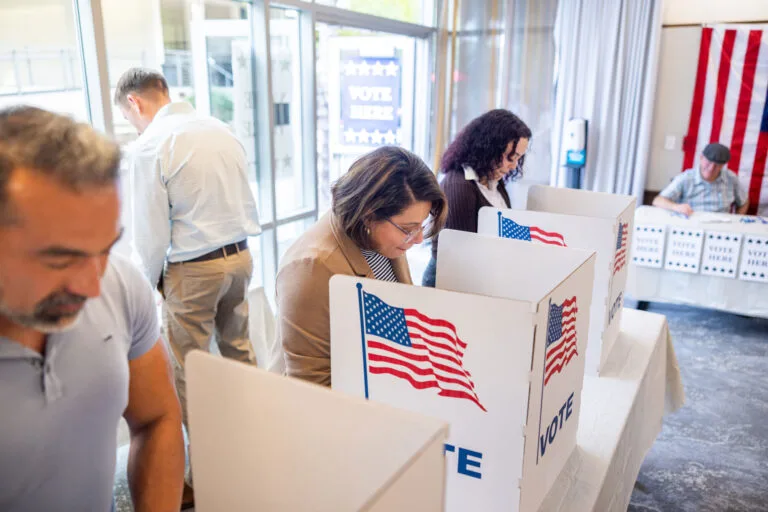
But voting rights are only one example. The filibuster also blocks major reforms in health care, climate, gun control, and immigration. A report from the Center for American Progress documents the impact of the filibuster on federal policymaking, noting that it has prevented the adoption of popular elements of health care reform. In other words, it is not only divisive bills that fail; measures enjoying broad public support cannot cross the 60-vote threshold.
The Senate is already a non-proportional institution: each state, regardless of its population, has two seats there. A senator from Wyoming represents about 580,000 inhabitants, while a senator from California represents nearly 40 million. Adding a supermajority requirement for ordinary laws accentuates this distortion. A minority of senators representing a small fraction of the population can block the will of the majority of Americans. Citizens for Responsibility and Ethics in Washington (CREW) pushes this reasoning to its conclusion: "The filibuster must go: restore majority rule to save our democracy."
The arguments of filibuster defenders: protecting the minority or paralyzing action?
Defenders of the filibuster do not lack arguments. The Federalist Society, for example, asserts that both major parties should preserve the legislative filibuster. According to it, this rule forces the search for bipartisan compromises and prevents abrupt shifts in public policy with each change of power. A Senate without a filibuster would become, according to this logic, a chamber where the majority of the moment could impose its agenda without negotiation, before the other party returns to power and undoes everything.
This argument has some force: the filibuster protects the minority against what James Madison called the "tyranny of the majority." But its detractors respond that the minority is already protected by the very structure of the Senate and by the Constitution. Moreover, the filibuster has been eroded asymmetrically: in 2013, Democrats used the "nuclear option" to allow the confirmation of federal judges by simple majority, and in 2017, Republicans did the same for the Supreme Court. As a result, the Senate can confirm judges with 51 votes, but cannot pass a voting rights law with fewer than 60 votes. This asymmetry makes the system incoherent and favors legislative gridlock.
The table below summarizes the main arguments at stake:
| Arguments for reform/abolition | Arguments against reform/abolition |
|--------------------------------------|---------------------------------------|
| The 60-vote rule gives a veto to 41 senators representing a minority of the population. | The filibuster protects minority rights and prevents the tyranny of the majority. |
| Historically used to block civil rights, it remains a tool of discrimination. | It encourages compromise and bipartisanship, avoiding extreme policies. |
| Near-systematic blocking paralyzes the Senate and prevents the government from responding to crises. | Its abolition would lead to abrupt legislative reversals with each change of majority. |
| It is not constitutional; the Constitution provides for simple majority for most votes. | It is part of Senate tradition and guarantees thorough deliberation. |
| The nuclear option has already eliminated the filibuster for nominations; it remains an obstacle only for laws. | Eliminating the legislative filibuster would concentrate too much power in the hands of the majority. |
The paths of reform: from abolition to lowering the threshold
Faced with the impasse, several avenues of reform are being put forward. None is neutral, and all carry political risks.

1. Outright abolition.
The most radical solution consists of eliminating the filibuster for all legislation, leaving only the simple majority as the rule. This is the position defended by CREW and by many progressives. Its supporters point out that the House of Representatives already operates on a simple majority and that the Senate is the only legislative chamber in the world to require a supermajority for ordinary laws. But this option would require a Senate vote, and senators are reluctant to give up a power that can serve them when they are in the minority.
2. Lowering the cloture threshold.
Another option consists of lowering the threshold from 60 to 55 votes, or even to 51 votes for certain categories of texts, such as voting rights laws or the budget. The Brennan Center for Justice raises the possibility of "reforming the filibuster to remedy its most significant abuses," without necessarily abolishing it. This targeted approach would make it possible to unblock priority files while preserving a certain role for the minority.
3. The return of the "talking filibuster."
Some propose restoring the obligation to actually speak in order to block a debate. If a senator wants to object, they would have to hold the floor, as in the days of great speeches. This requirement would increase the political and physical cost of obstruction, reserving it for truly important causes. But it does not guarantee the passage of laws, and it can also lead to mediatized spectacles of obstruction.
4. Sectoral exemptions.
The Senate has already created exceptions to the filibuster for certain procedures, such as the budget via reconciliation (which requires only 51 votes). Some propose extending these exemptions to other areas, such as voting rights or nominations. This pragmatic approach avoids touching the general rule while allowing progress on the most urgent subjects.
None of these avenues enjoys consensus, and the debate remains deeply political. The Federalist Society warns against any modification that would weaken the protection of minorities, while reformers emphasize the democratic urgency.
Consequences for American governance: a dysfunctional Senate?
The filibuster has concrete effects on the federal government's ability to act. The Center for American Progress has documented how the filibuster has blocked popular reforms, particularly in the area of health care. For example, elements of health insurance reform that enjoyed broad public support could not be adopted because of the 60-vote threshold. This blockage is not limited to one party: it affects citizens' trust in institutions. If an elected majority cannot keep its promises because of an obscure rule, the feeling of powerlessness grows and fuels democratic disaffection.
This situation is all the more paradoxical because the Senate has already modified its rules for nominations, but not for laws. The asymmetry is striking: a president can have judges confirmed for life with a simple majority, but cannot have a law on climate or voting rights adopted without 60 votes. This inconsistency fuels criticism that the filibuster serves more to protect the status quo than to guarantee genuine deliberation.
In international comparison, the American Senate is an exception. In most parliamentary democracies, the upper chamber (when it exists) has only a suspensive power or is elected according to rules that do not give a minority a right of veto over all legislation. The requirement of 60 votes for ordinary laws places the United States in a unique situation, where the minority can block almost everything.
Returning to the Starting Point: Why This Debate Cannot Be Ignored
The image from January 2022 – 50 Democratic senators united on voting rights but unable to act – sums up the dilemma of the contemporary Senate. The filibuster rule, originally designed to guarantee informed debate, has become an instrument of systematic obstruction. It prevents not only progressive reforms, but also any major legislative action, regardless of which party is in power.
The debate over the filibuster is not a simple procedural quarrel. It raises a fundamental question: should the Senate be a chamber where the majority governs, or a chamber where a minority can exercise a permanent veto right? The answer to this question will determine the United States' ability to meet the challenges of the 21st century. For professionals who follow American politics, understanding this mechanism is essential, because it conditions the feasibility of all major reforms.
The filibuster is like an emergency brake that has turned into a permanent handbrake. It is time to decide whether to loosen it, repair it, or remove it – but ignoring it is no longer an option.
Further Reading
- PBS - The debate over ending the filibuster, explained: video report explaining the debate over abolishing the filibuster and its impact on voting rights.
- Brennan Center for Justice - The Filibuster Explained: detailed analysis of the procedure and its historical use against civil rights.
- Brennan Center for Justice - The Case Against the Filibuster: argument in favor of reforming the filibuster in the face of its abuses.
- Federalist Society - Why Both Parties Should Preserve the Senate's Legislative Filibuster: argument in favor of maintaining the legislative filibuster.
- Rep. Sewell - Calls on Senators to Reform the Filibuster and Pass Federal Voting: statement from Representative Sewell on voting restrictions and the need to reform the filibuster.
- Center for American Progress - The Impact of the Filibuster on Federal Policymaking: study on the consequences of the filibuster for policymaking.
- Congressional Research Service - Filibusters and Cloture in the Senate: technical document on filibuster and cloture rules.
- Citizens for Responsibility and Ethics in Washington - The filibuster must go: Restore majority rule to save our democracy: advocacy report calling for the abolition of the filibuster.