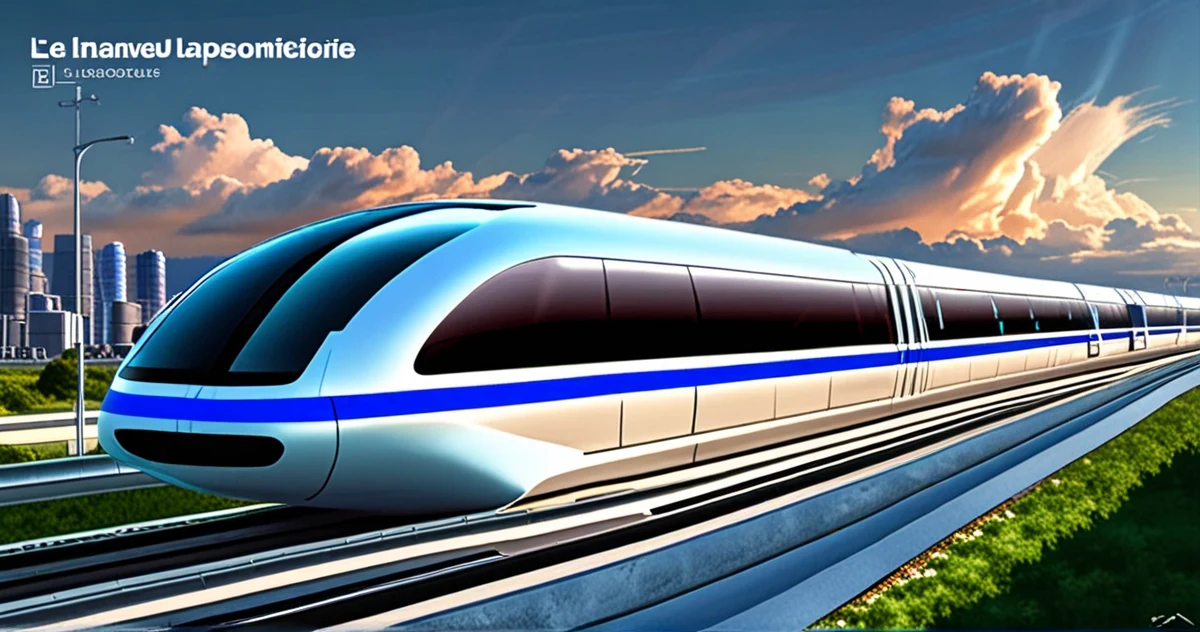
In 2025, a Japanese train could theoretically connect Tokyo to Nagoya in 40 minutes at 500 km/h, without touching the rails. This technological feat, the Maglev L0 Series, indeed exists. Yet, unlike the Shinkansen which transformed Japan in the 1960s, this futuristic train has not triggered a transportation revolution. Its journey illustrates a modern paradox: how can a brilliant technology fail to change the world?
Maglev (magnetic levitation) is a system where the train levitates using electromagnets, eliminating wheel friction. According to Wikipedia, this technology allows for theoretical speeds far exceeding those of conventional trains. The L0, developed by the Central Japan Railway Company (JR Central), even holds the world rail speed record at 603 km/h. But behind these impressive figures lies a more complex reality.
This article explores why the Maglev L0, despite its undeniable technological advancement, has not revolutionized transportation as expected. We will analyze the economic obstacles, infrastructure challenges, and the lessons this relative failure offers for future innovation projects, especially in the face of the rising power of other countries like China in advanced industries.
An engineering feat imprisoned by its cost
The first barrier is economic. Building a Maglev line requires pharaonic investments. The Chūō Shinkansen line between Tokyo and Osaka, designed for the L0, is estimated at over 9 trillion yen (approximately 60 billion euros). These astronomical costs are explained by the unique infrastructure: U-shaped guides containing superconducting coils that must be installed on viaducts or in tunnels over long distances, notably through the Japanese Alps.
Compared to conventional Shinkansen, the return on investment is uncertain. A Tokyo-Nagoya ticket on the Maglev would cost significantly more than on the current Shinkansen, limiting its appeal to the general public. In a country where omotenashi – the spirit of Japanese customer service and hospitality – is central, as described on the Kbjanderson blog, offering a premium service at a prohibitive price goes against the accessibility that characterizes Japanese transportation.
The shadow of the existing Shinkansen
The Maglev L0 suffers from a classic disruption problem: it must compete with an already excellent technology. The current Shinkansen network is one of the most reliable, punctual, and comfortable in the world. Travelers can already book their tickets via apps like SmartEx (even though some users report difficulties with international credit cards, as reported on Reddit). Why change a system that works almost perfectly?
The answer is not just about speed. As analyzed in a scientific article on ScienceDirect concerning urban transport, the success of a new mode of transportation depends on its integration into the existing ecosystem, its financial accessibility, and the real added value it provides. Does saving 40 minutes between Tokyo and Nagoya justify a doubling of the ticket price and decades of disruptive construction? For many users and decision-makers, the answer is no.
The environmental challenge in a post-COP world
In the current context of climate crisis, any new transportation project is judged by its environmental impact. The IPCC report on transport (Chapter 10) emphasizes that meeting climate mitigation goals requires transformative changes in the sector. The Maglev, although electric, raises questions:
- The energy required to levitate and propel a train at 500 km/h is considerable
- The construction of hundreds of kilometers of new concrete and steel infrastructure has a massive carbon footprint
- It diverts investments that could be used to electrify or improve existing transport networks, including freight, whose decarbonization is urgent
Contrary to a common belief, a faster technology is not automatically more sustainable. The environmental cost-benefit analysis of the Maglev is less favorable than it appears.
Global competition and the Chinese case
While Japan struggled to deploy its Maglev, other countries advanced. China, in particular, has become a leading innovator in advanced industries, as noted in a 2025 ITIF report. Its conventional high-speed rail network is now the most extensive in the world. If China also develops Maglev technologies (like the commercial line in Shanghai), it often does so at a much lower cost and with a deployment speed that contrasts with Japanese slowness.
This dynamic challenges Japan's competitive advantage. Innovation is not enough; the ability to deploy it on a large scale and at an acceptable cost is also necessary. The L0 case suggests that the Japanese model, excellent in R&D and quality, can be handicapped by slow decision-making processes and high construction costs.
Hyperloop and other mirages: the lesson of caution
The history of the Maglev L0 offers a warning for other futuristic transportation projects, like the Hyperloop. On Reddit and in critical analyses, the Hyperloop is often described as an intrinsically problematic idea for mass transport, pushing technical and economic limits even further than Maglev. As noted on Ramin Skibba's blog on energy policy, engineers do not even yet know precisely how an Hyperloop would function on a large scale – using expensive Maglev technology or floating on pressurized air.
The Maglev L0 demonstrates that between a laboratory prototype and a viable commercial network, there is a chasm that few technologies cross. The promised "revolution" always runs into the same constraints: cost, social acceptance, infrastructure integration, and increasingly, the climate imperative.
What the Maglev L0 truly teaches us about innovation
The relative failure of the Maglev L0 to revolutionize transportation is not a failure of the technology, but a failure of its fit with the real world. It teaches us several crucial lessons:
- Speed is not the only metric that matters. Reliability, frequency, price, and comfort are just as important for users.
- A disruptive technology must offer an order-of-magnitude improvement, not just a marginal one. Going from 270 to 500 km/h is impressive, but it does not fundamentally change the passenger experience like the shift from conventional trains to the Shinkansen did.
- The regulatory and economic context can kill the best of inventions. Construction costs in Japan, expropriation procedures, and extreme safety standards have made the project disproportionately expensive.
- "Timing" is crucial. Launched in a period of economic stagnation and environmental priority, the Maglev may have missed its historical window of opportunity.
> Key takeaways:
> - The Maglev L0 is a technical marvel but a relative commercial failure.
> - Its pharaonic cost and marginal benefit for the user have limited its impact.
> - It suffers from comparison with the existing Shinkansen network, which is already excellent.
> - Its slow deployment contrasts with the rise of innovators like China.
> - Its case warns against the overly beautiful promises of futuristic transportation technologies.
Ultimately, the Maglev L0 Series will likely remain in history as an engineering masterpiece that pushed the limits of the possible, but also as a salutary reminder: a transportation revolution is not decreed in a laboratory. It is born from the meeting between a technology, a pressing societal need, and a viable economic model. For now, the L0 has only found the first of these three ingredients.
The next revolution may come less from a race for speed than from a reconquest of efficiency, sustainability, and accessibility. And that, paradoxically, could be an even more valuable lesson than mastering magnetic levitation.
To go further
- Maglev - Wikipedia - Encyclopedia article on magnetic levitation technology.
- Life in Japan: Omotenashi - Kbjanderson - Blog on the spirit of customer service and hospitality in Japan.
- China Is Rapidly Becoming a Leading Innovator - ITIF - Report on China's rise as a leading innovator in advanced industries.
- Light rail in urban regions - ScienceDirect - Academic article on the success conditions for public transport.
- Chapter 10: Transport - IPCC - Chapter of the IPCC report on transport and climate.
- CMV: The Hyperloop is an intrinsically stupid idea - Reddit - Critical discussion on the challenges of the Hyperloop.
- Energy Policy - Ramin Skibba - Blog analyzing energy and technology policies.
- smartex app can't register credit card? - Reddit - User testimony on booking Shinkansen tickets.