
Imagine a city where every car trip is replaced by an electric scooter. The reduction in emissions seems obvious, but the reality is much more nuanced. According to a study published in Environmental Sciences Europe, the full life cycle analysis of micro-mobility devices reveals often underestimated environmental impacts, questioning their supposed systematic ecological advantage.
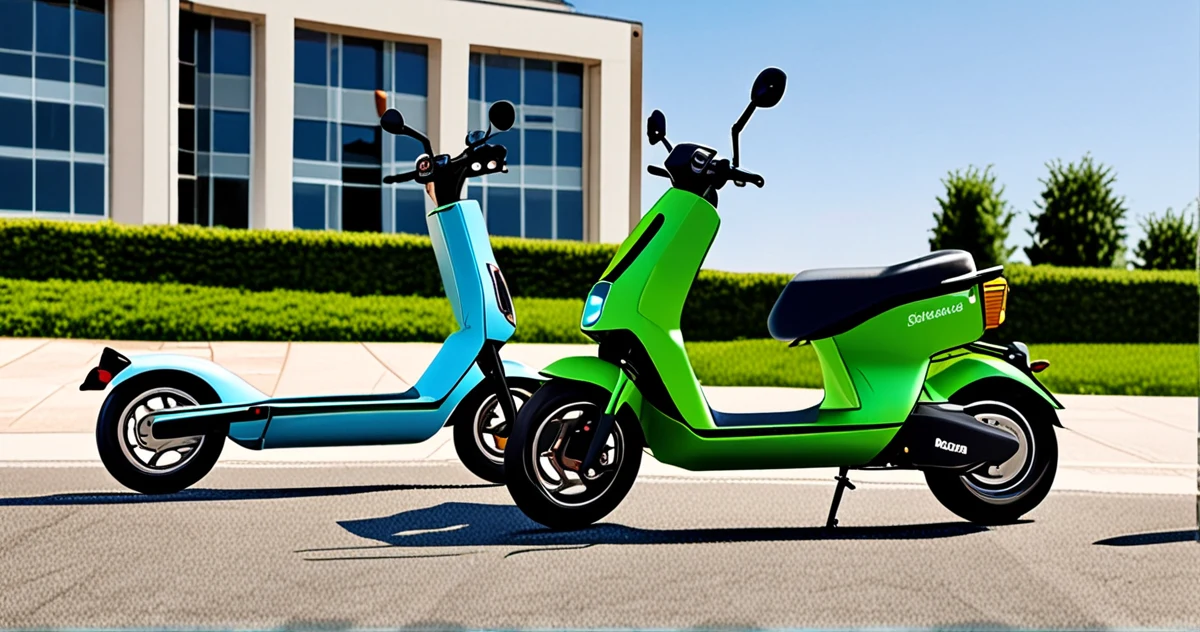
Shared micro-mobility - including bikes, scooters, and other light vehicles in free-floating services - is presented as a key solution for decarbonizing urban transport. Yet, behind this enthusiasm lies a complex debate about its true environmental footprint. This article examines the available evidence to determine whether these services actually reduce our carbon footprint or simply create the illusion of sustainable mobility.
Life cycle analysis: an essential revealer
Environmental assessment cannot be limited to usage emissions. As highlighted by the consolidated study from Environmental Sciences Europe, production, maintenance, and end-of-life of vehicles represent a significant portion of their impact. For shared electric scooters, manufacturing batteries and frames, combined with often short lifespans, can cancel out some of the expected benefits.
Critical factors include:
- Carbon intensity of vehicle production
- Frequency of recharging and maintenance operations
- Emissions related to transport for reconditioning
- Component replacement rates
Substitution or complement? The case of young adults
Research using American data, cited by ScienceDirect, analyzes the relationship between shared mobility services and greenhouse gas emissions among young people. Results show that the net impact largely depends on which transport mode is replaced. When micro-mobility substitutes walking or public transport, its balance can become negative. Conversely, replacing personal car trips generates significant emissions reductions.
This paradox highlights that environmental efficiency depends less on the technology itself than on the behaviors it induces.
Comparison of environmental impacts by transport mode
| Transport Mode | CO2 Emissions/km | Production Impact | Lifespan | Effective Substitution |
|-------------------|------------------|-------------------|--------------|----------------------|
| Internal combustion car | 180-250g | High | Long | - |
| Electric scooter | 50-100g | Medium-high | Short | Personal car |
| Mechanical bicycle | 0g | Low | Long | Long walks |
| Public transport | 30-80g | Low | Long | Personal car |
The systematic review: a mixed overall picture
A comprehensive analysis of scientific literature, referenced by Taylor & Francis Online, confirms the diversity of environmental impacts from shared mobility services. While some studies show potential emissions reductions, others point to rebound effects and counterproductive substitutions.
The variability in results is explained by:
- Methodological differences between studies
- Specificity of urban contexts
- Duration of behavior observation
- Assumptions about local energy mix
The challenge of measurement and comparison
As noted by MDPI in its research on life cycle emissions, promoting micro-mobility services as green alternatives has sparked debate about their role in urban mobility. The difficulty lies in establishing reliable comparative benchmarks. Is an electric scooter more virtuous than a full diesel bus? The answer depends on many local parameters, making generalizations risky.

Concrete examples of environmental impact
Paris case: Electric scooters mainly replaced walking or metro trips, limiting their net environmental benefit.
Los Angeles case: In a city heavily dependent on cars, micro-mobility significantly reduced emissions by replacing short car trips.
Copenhagen case: Integration of shared bikes with existing networks amplified environmental benefits.
Practical implications for decision-makers
To maximize the environmental potential of shared micro-mobility, several action levers emerge:
- Integration with existing transport networks: Ensure complementarity rather than competition with public transport
- Sustainable design: Prioritize robustness, repairability, and use of recycled materials
- Logistical optimization: Minimize kilometers traveled for maintenance and redistribution
- Usage regulation: Guide services toward trips where they effectively replace cars
Evolution and research perspectives
Science is evolving rapidly in this field. Recent work, such as those cited by ScienceDirect on shared electric bikes, is beginning to more precisely quantify potential emissions reductions. However, the lack of standardized data and the complexity of urban systems require more sophisticated methodological approaches.
Future research should focus on:
- Longitudinal analysis of behavioral changes
- Evaluation of accompanying policies
- Modeling scenarios at different territorial scales
- Optimization of vehicle life cycles

Conclusion: beyond technology, usage is decisive
The debate on the environmental impact of shared micro-mobility cannot be settled with a binary answer. Current evidence suggests these services are neither an ecological panacea nor a false solution, but a tool whose effectiveness fundamentally depends on its integration into the urban mobility ecosystem.
Reducing carbon emissions depends less on adopting new technologies than on deeply transforming our travel habits. Micro-mobility services can contribute to this, provided they are conceived as links in a coherent system rather than isolated solutions.
To go further
- Environmental Sciences Europe - Life cycle analysis of electric scooters
- ScienceDirect - Relationship between shared mobility and emissions among young people
- Taylor & Francis Online - Systematic review of environmental impacts
- MDPI - Life cycle emissions of shared services
- ScienceDirect - Impact of shared electric bikes on emissions
- Mapfre - Overview of sustainable mobility
- Modeshift - Potential for reducing car usage