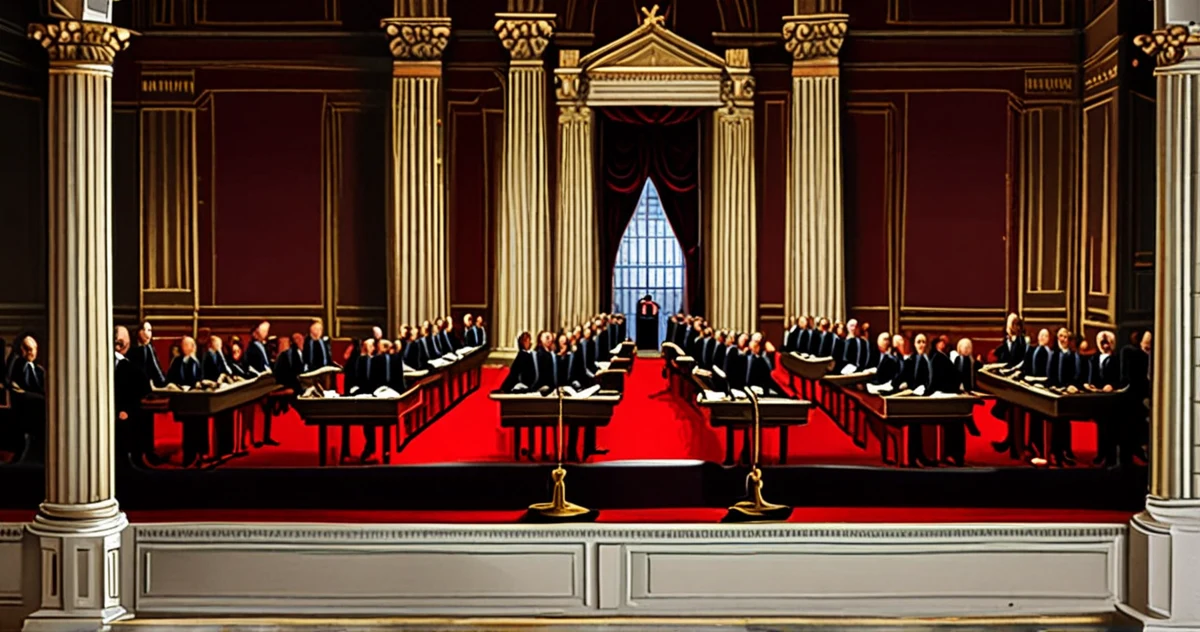
Imagine a president attempting to nationalize steel mills during wartime, claiming to act for national security. This real situation, decided by the Supreme Court in Youngstown Sheet & Tube Co. v. Sawyer (1952), illustrates how judges can restrain the executive to preserve constitutional balance. Understanding the separation of powers is not just legal theory; it's grasping the mechanisms that prevent any abuse of authority in a democracy. For digital professionals, often faced with complex regulations, mastering these fundamentals provides keys to anticipate decisions that impact their sector.
This article guides you through landmark Supreme Court rulings that defined the boundaries between the legislative, executive, and judicial branches. We will explore concrete cases, identify warning signs when this balance is threatened, and avoid common mistakes in interpreting these principles. Prepare to see the Constitution in a new light, through judgments that shaped American history.
Marbury v. Madison: The Birth of Judicial Review
The Marbury v. Madison (1803) ruling is the cornerstone of the separation of powers in the United States. As recalled by a West Virginia legislator document citing this ruling, the Supreme Court established that "a law repugnant to the Constitution is void." Concretely, this means that the judiciary has the final say on the constitutionality of laws, a principle known as judicial review. In this case, the Court, presided over by Justice John Marshall, refused to apply a congressional law it deemed unconstitutional, thus affirming its role as guardian of the Constitution.
Practical application: Today, this principle allows technology companies to challenge laws they believe violate their rights, such as data protection or net neutrality. For example, if a law imposes widespread surveillance without a warrant, courts can invalidate it by relying on Marbury v. Madison.
Warning signs: Be wary when government branches attempt to bypass judicial review, for example by adopting executive orders without clear legislative basis. This may indicate a growing imbalance of powers.
Youngstown v. Sawyer: Limiting Executive Power in Times of Crisis
In Youngstown Sheet & Tube Co. v. Sawyer (1952), President Harry Truman seized steel mills to prevent a strike during the Korean War, invoking emergency powers. The Supreme Court ruled this act unconstitutional, emphasizing that only Congress could authorize such action. As noted by the Federal Judicial Center, this ruling is an emblematic example of the separation of powers, where the judiciary prevented the executive from encroaching on the legislative domain.
Lesson for the digital sector: In a crisis, such as a major cyberattack, a president might be tempted to take radical measures without congressional approval. Youngstown reminds us that even emergency does not justify overstepping constitutional limits.
Common mistake: Believing that the executive can act unilaterally in all areas "for the public good." In reality, every action must rely on an existing law or clear authorization from Congress.
Modern Rulings and the Regulatory State
With the growth of the regulatory state, the Supreme Court has had to arbitrate conflicts between independent agencies and other branches. For example, in Free Enterprise Fund v. Public Company Accounting Oversight Board (2025), the Court examined the structure of an agency created by Congress, highlighting the limits of power delegation. As explained by academic analysis, these cases show how the judiciary adapts the separation of powers to administrative complexity.
Concrete application: For a startup facing regulations, understanding who truly holds power – Congress, the executive, or an agency – helps navigate legal remedies. If an agency oversteps its mandate, courts can intervene.
Warning signs: When agencies adopt rules without precise legislative mandate, or when Congress delegates too much power without oversight, the constitutional balance is at risk.
Pitfalls to Avoid in Interpreting the Separation of Powers
- Confusing separation and isolation: Powers are distinct but collaborative; for example, the president appoints judges, but the Senate confirms them. An overly rigid interpretation can lead to gridlock.
- Neglecting historical context: Rulings like Marbury or Youngstown reflect political realities of their time. Applying them without adaptation can lead to erroneous conclusions.
- Overestimating the judiciary's role: The Supreme Court does not create laws; it interprets the Constitution. Expecting it to provide solutions to all societal problems is a common mistake.
Example of error: After Marbury, some believed the Court could overturn any unpopular law. In reality, its power is limited to constitutional questions, and it often avoids ruling on purely political disputes.
Implications for Digital Professionals
The separation of powers directly affects the digital sector, from privacy laws to antitrust regulations. By understanding key rulings, entrepreneurs can anticipate legal risks and defend their interests. For example, if an AI law is adopted without sufficient legislative debate, drawing inspiration from Youngstown could allow challenging it.
Perspective: As technologies evolve rapidly, the Supreme Court will likely continue to play a crucial role in balancing innovation and rights protection. Staying informed about these jurisprudences is not optional but essential for navigating the digital ecosystem.
In summary, the separation of powers, forged by rulings like Marbury v. Madison and Youngstown v. Sawyer, remains a living pillar of American democracy. For digital actors, these principles provide tools to challenge abuses and participate in constitutional debate. Do not underestimate their power: by studying these cases, you become not just a technical expert, but an informed citizen.
To Go Further
- Uscourts Gov - Role and structure of federal courts, including district courts
- Wvlegislature Gov - Text referencing Marbury v. Madison and constitutional supremacy
- Uscourts Gov - Resources on landmark Supreme Court rulings
- Spia Uga Edu - Testimony on teaching constitutional law with historical cases
- Statecourtreport - Analysis of recent state constitutional cases
- Fjc Gov - Examination of judicial review of executive orders, including Youngstown
- Supreme Justia - Supreme Court decisions on separation of powers
- Scholarship Law Bu Edu - Academic analysis on separation of powers and the regulatory state