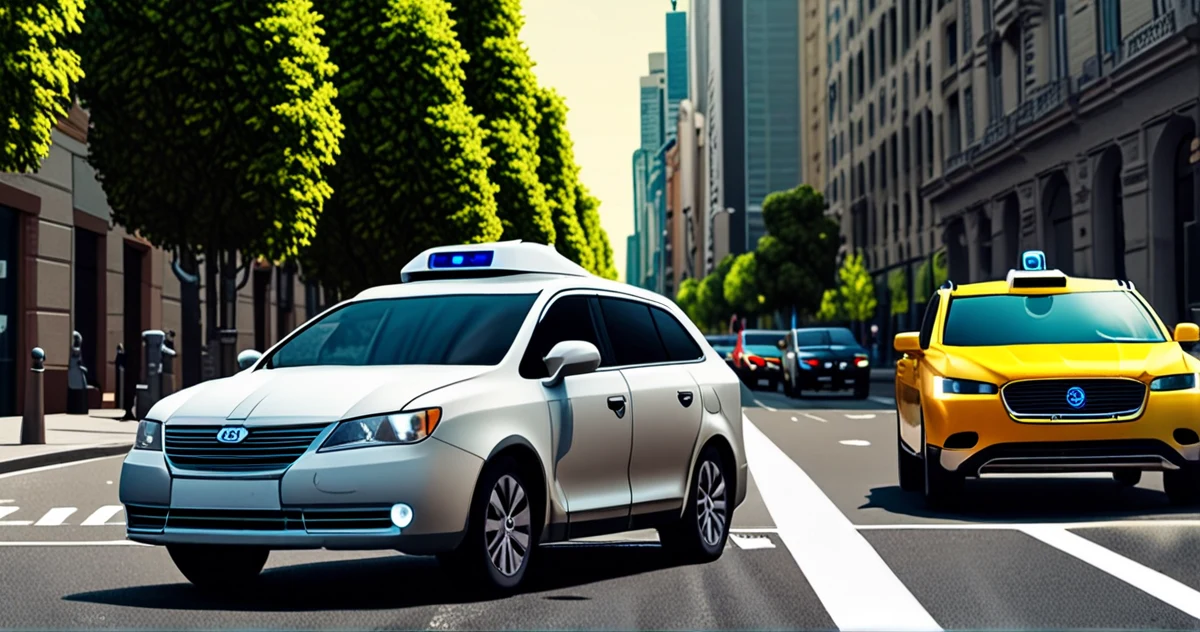
A robotaxi brakes suddenly to avoid an imaginary pedestrian. The vehicle behind it doesn't have time to react: collision. Who pays? The manufacturer? The fleet operator? The software owner? Or, more prosaically, the insurance of the struck vehicle? This scene, still rare but bound to multiply, crystallizes one of the blind spots of the autonomous revolution: the insurance regime.
As Waymo, Cruise, and others accelerate the deployment of their driverless fleets, traditional legal frameworks, designed for human-driven vehicles, are showing their limits. Drivers and insurers must prepare for a new paradigm where the notion of "fault" shifts from the driver to the algorithm.
A Legal Framework Under Construction
In the United States, the absence of uniform federal regulation leaves each state to legislate as it sees fit. California led the way by requiring robotaxi operators to take out insurance coverage of $5 million per incident. As reported by Zinn-law, this amount, far higher than usual caps, aims to guarantee compensation for victims in the event of a serious accident involving an autonomous vehicle.
But this requirement doesn't solve everything. It sets an amount, but not the implementation modalities. Who pays the premium? The technology company? The vehicle owner? And if the robotaxi is used as a ride-hailing service, as Waymo proposes? Autonomous ride-sharing services blur the lines even further: the passenger has no control over the vehicle, but is on board. Could their own personal insurance be called upon?
Liability: A Shift from Driver to Code
In a classic accident, liability rests on the driver's behavior. With a robotaxi, the driver no longer exists. The automated driving system is in control. In the event of a failure, liability shifts to the software designer, the sensor manufacturer, or the fleet operator.
Specialized lawyers, like those at Lancebingham, observe an increase in claims related to robotaxi accidents, including at Waymo. 2026 statistics show that while accidents remain less frequent than those involving human drivers, they raise complex liability questions: is the fault due to a sensor perception error, a software update defect, or insufficient vehicle maintenance?
In practice, victims of a robotaxi accident can turn to the operator's insurance (the $5 million one in California), but also potentially to the manufacturer for product defect. In this context, lawsuits become insurance law cases combined with technology litigation, as highlighted by Legalrideshare.
The Special Case of Semi-Autonomous Vehicles
Not all autonomous vehicles are equal. Partially automated driving systems (Level 2 or 3), like Tesla's Autopilot, place the driver in a supervisory role. In the event of an accident, liability generally remains attributed to the driver, as Cheeleylawgroup reminds us. But when Level 4 or 5 (no human intervention possible) is involved, the cursor shifts.
This distinction is essential for insurers, who must adjust their premiums based on the level of autonomy. Owners of fully autonomous vehicles might see their premiums drop, as the risk related to human error is reduced—but the risk of technical failure remains. As McKinsey mentions, consumers might no longer have to pay high premiums, as liability would be transferred to the manufacturer or operator.
Concrete Scenarios: Who Pays What?
| Scenario | Likely Responsible Party | Insurance Involved |
|----------|--------------------------|-------------------|
| Robotaxi hits a pedestrian due to a software error | Operator / developer | Operator's liability insurance ($5M in California) |
| Owner of a Level 4 autonomous vehicle involved in an accident due to mechanical failure | Manufacturer | Manufacturer's product insurance |
| Driver of a semi-autonomous vehicle (Level 2) distracted at the wheel | Driver | Driver's personal insurance |
These scenarios show that the chain of liability can be long and complex, involving multiple actors. In the absence of abundant case law, courts play a key role in clarifying the rules.
The Insurance Industry Facing the Data Challenge
To assess risk, insurers need data. However, autonomous vehicle accidents are still rare, and driving data is often proprietary. Insurers struggle to build reliable actuarial models. Some are beginning to demand access to vehicles' onboard data, raising privacy concerns.
Moreover, the potential cost of claims is higher: an accident caused by a software defect can lead to costly recalls and chain liability. Insurers must therefore pool risk on a larger scale, possibly through dedicated autonomy insurance pools.
Toward a New Insurance Model
Several avenues are emerging. One is "product" insurance integrated into the vehicle, where the manufacturer or operator takes out a policy covering all incidents related to the autonomous system. Another is "per-trip" insurance, where each robotaxi ride is individually insured, with the cost included in the fare.
Some experts, like those interviewed on Reddit, envision a system where insurance is attached to the vehicle rather than the driver, with a single premium paid by the fleet owner. This would simplify management for users but complicate pricing for insurers.
Conclusion
The question of robotaxi insurance is far from resolved. The few hundred thousand miles driven in autonomous mode are not enough to establish reliable statistics. Regulators are fumbling, courts have not yet ruled on landmark cases, and insurers are feeling their way forward.
One thing is certain: the current model, centered on the driver, will have to evolve toward a technology-centered model. Companies developing robotaxis have every interest in anticipating these changes to avoid being caught off guard. And consumers, for their part, will need to understand that getting into a driverless vehicle also means accepting a new risk-sharing arrangement.
So, next time you hail a robotaxi, ask yourself: who will pay if the ride goes wrong?
Further Reading
- Zinn-law - California's $5 Million Autonomous Rideshare Insurance - Details on California's $5 million requirement.
- Lancebingham - Waymo Accident 2026 Statistics and What It Means for Injury Claims - Analysis of Waymo accident statistics and legal implications.
- Lvaccident - Las Vegas, NV — Who Is Liable When Self-Driving Cars Crash? - Liability questions in self-driving car accidents.
- Reddit - Ok, the future, everyone has one, who pays for insurance? - Discussion on future insurance models.
- McKinsey - Autonomous driving's future: Convenient and connected - Perspectives on insurance premium evolution.
- Cheeleylawgroup - Alpharetta Self-Driving Vehicle Accidents Lawyer - Distinction between semi-autonomous and fully autonomous vehicles.
- NHTSA - Automated Vehicle Safety - Official information on automated vehicle safety.
- Legalrideshare - Chicago Robotaxi Accident Lawyer for Passengers - Legal advice for passengers in robotaxi accidents.