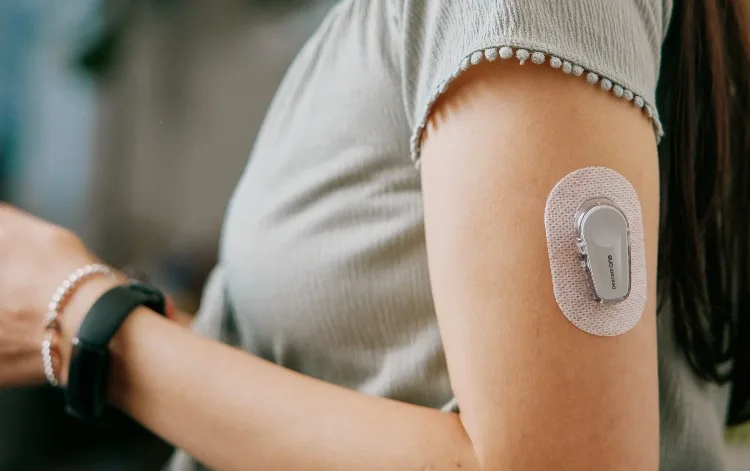
Unlike the traditional blood glucose meter, which requires a finger prick for each measurement, a continuous glucose monitor (CGM) is attached directly to the abdomen or arm. The CDC describes the device as follows: it uses a tiny plastic tube to measure glucose continuously. This fundamental difference—spot versus continuous—raises a central question for patients, clinicians, and health systems: which technology offers the best balance between accuracy, ease of use, and clinical value in daily life?
The available data, particularly the comparative studies identified by the National Institutes of Health and the recommendations of public health organizations, help to clarify this. This article compares the two approaches through the lens of evidence, user experience, and medium-term development scenarios. It is intended for digital professionals, designers of connected health solutions, and decision-makers seeking to understand the technical and practical implications of these devices.
Two technologies, two measurement philosophies
The capillary blood glucose meter, often called a glucometer, relies on a simple principle: a drop of blood taken from the fingertip is placed on a reagent strip inserted into the device, which then displays the glucose concentration. This method provides an instantaneous value, but it is discrete, meaning it only provides information about the precise moment of measurement. To obtain a glucose curve, the patient must multiply the pricks, sometimes up to four to ten times a day depending on their treatment.
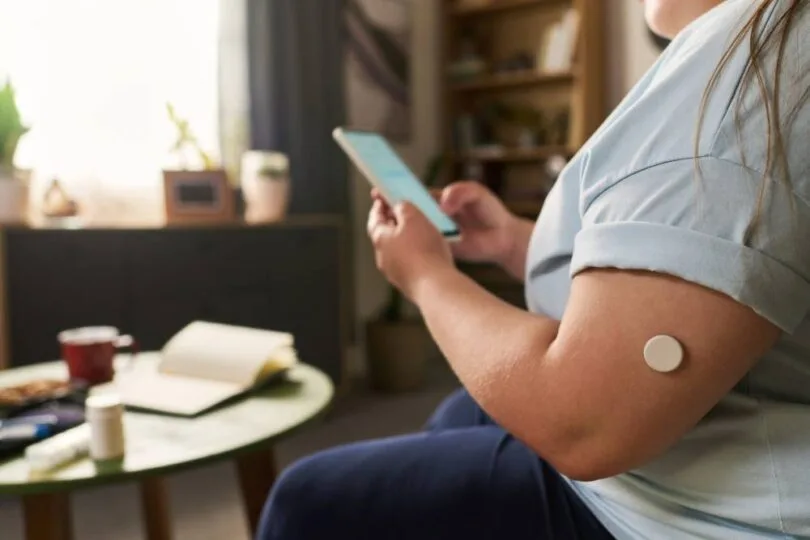
The CGM, on the other hand, inserts a fine sensor under the skin that measures glucose in the interstitial fluid, not in capillary blood. This sensor transmits the data to a receiver or a smartphone, offering a near-continuous reading and trends (rising or falling arrows). As the CDC points out, this technology eliminates the need to prick the finger for each measurement, even though some models still require periodic calibration using a traditional glucometer.
This difference in the fluid measured has an important physiological consequence: when blood glucose changes rapidly (after a meal, during intense exercise, or during hypoglycemia), the concentration in the interstitial fluid may lag a few minutes behind capillary blood. This delay, called "lag time," is a key variable for correctly interpreting the data.
What the data say about accuracy
Clinical studies comparing CGM and conventional blood glucose self-monitoring have multiplied. A review accessible via PubMed Central (PMC11745360) notes that diabetic patients were long forced to resort to finger pricks to monitor their blood glucose, but that CGMs now offer an alternative whose accuracy has been validated in various populations. Another publication (PMC6822918) directly compares the two methods and concludes that CGMs provide a reliable measurement of interstitial glucose, with a close correlation to capillary values, provided that the physiological delay is taken into account.
The CDC confirms that CGMs are considered accurate for clinical use, while Aetna documents indicate that some single-sensor systems allow continuous and accurate glucose display, subject to compliance with the conditions of use.
However, this must be nuanced: the accuracy of a CGM is not uniform in all situations. Performance may be affected by:
- A rapid change in blood glucose (the interstitial sensor "follows" with a delay).
- Severe dehydration or hypotension.
- Placement or calibration errors (for models that require it).
- The use of certain medications (high-dose paracetamol for some sensors, for example).
Conversely, the capillary glucometer is generally very accurate under normal conditions of use, but it is subject to errors related to handling: poorly washed hands, expired strips, inappropriate storage temperature, insufficient blood volume. Studies show that, in real life, user error is a major source of inaccuracy for both technologies.
How is accuracy assessed?
Clinical studies generally compare CGM values with reference laboratory measurements (venous blood glucose) or calibrated capillary glucose meters. Publications indexed on PubMed Central report high correlations between the two methods under stable conditions, with wider dispersion during rapid changes. Researchers insist on the need to assess accuracy not only in absolute value, but also in terms of trend: a correct upward or downward arrow can be clinically more useful than a slightly offset exact value.
Daily use: what changes for the patient
Switching from a conventional reader to a CGM transforms the monitoring experience. The following table summarizes the main operational differences.
| Criterion | Capillary blood glucose reader | Continuous glucose monitor (CGM) |
|---------|-------------------------------|--------------------------------------|
| Measurement frequency | Point-in-time, with each fingerstick | Continuous, with automatic transmission |
| Invasiveness | Fingerstick at each measurement | Insertion of a fine sensor under the skin, worn for several days |
| Available data | Instantaneous value only | Instantaneous value, trend (arrows), complete history |
| Alerts | None | High/low threshold alerts, sometimes predictive |
| Calibration | Not required | Depending on the model: capillary or factory calibration |
| Cost | Inexpensive device, but recurring consumables | Sensor to be replaced regularly, reusable transmitter, high initial cost |
| Learning curve | Low | Higher: interpretation of trends, alert management |
For many patients, the most tangible benefit is the reduction in the number of fingersticks. A person on intensive insulin therapy can avoid several dozen fingersticks per week. In addition, nighttime alerts make it possible to detect silent hypoglycemia that would go unnoticed with point-in-time checks. Trend data also help to adjust diet, physical activity and insulin doses with greater precision.
However, CGM is not without constraints. Wearing a sensor can cause skin irritation, peel off during sports or water activities, or generate fatigue linked to the constant flow of data and alerts (sometimes called "alarm fatigue"). Some patients also feel anxiety about constant monitoring.
Take the fictional example of Sophie, 35, who has had type 1 diabetes for 20 years. She has been using a CGM for three years and has reduced her fingersticks from eight to two per week. She appreciates seeing the trend arrow before going to bed, but admits she keeps a glucose meter in her bag "just in case" and is wary of the values when she sweats a lot. This case illustrates a frequently reported reality: CGM complements rather than fully replaces the capillary reader.
The point of view of the stakeholders: patients, clinicians, payers
Perspectives differ depending on the stakeholder.
Patients: For many, CGM represents a major advance in terms of comfort and safety. The ability to share data in real time with a relative or caregiver is also a factor in adherence. But cost remains a major obstacle, especially for people not covered by insurance or in countries with low reimbursement. The question of insurance coverage is therefore central.
Clinicians: Health professionals see CGM as a powerful tool for adjusting treatments based on complete glycemic profiles rather than a few isolated measurements. This makes it possible to identify patterns (postprandial hyperglycemia, nocturnal hypoglycemia) that are invisible with a glucose meter. However, as Yale Medicine notes, the question of who should use a CGM goes beyond patients on insulin alone: people with type 2 diabetes not on insulin or even with prediabetes could benefit from it, but the evidence and reimbursement models are not yet aligned.
Payers and regulators: Insurers, as shown in the Aetna document, strictly frame the conditions for coverage of CGMs and associated software. The criteria often include the type of diabetes, the treatment regimen, the frequency of hypoglycemia and the ability to use the data. The cost of sensors and transmitters, as well as the need to download and analyze the data, are factors taken into account.
Three scenarios for 2030: toward needle-free monitoring?
What will glucose monitoring look like in a few years? Three trajectories are emerging.
Optimistic scenario: CGM becomes the standard for all diabetics
In this scenario, sensor costs fall thanks to economies of scale and innovation, automatic calibration algorithms improve, and closed-loop systems (artificial pancreas) become widespread. Continuous data feed artificial intelligence models capable of predicting glycemic trends 30 minutes ahead, thereby reducing hypo- and hyperglycemic episodes. Health authorities recognize the preventive value of CGM for at-risk individuals, expanding reimbursement to prediabetes and non-insulin-treated type 2 diabetes. The capillary glucometer remains a backup tool, used only to check a faulty sensor or in case of doubt.
What must happen: a significant drop in the unit price of sensors, studies demonstrating clinical and economic benefit in non-insulin-treated populations, and massive training of health professionals in the interpretation of continuous data.
Pessimistic scenario: a technological divide persists
Here, costs remain high, access inequalities widen between insured patients and others, and CGM accuracy in certain situations (rapid variations, critical states) limits its universal adoption. Clinicians, overwhelmed by the volume of data, struggle to integrate it into daily practice, and some patients abandon the device due to information overload or skin problems. The traditional glucometer remains the standard for a majority of patients worldwide.
What must happen to avoid this scenario: inclusive reimbursement policies, adapted therapeutic education programs, and technical improvements to reduce skin constraints and improve accuracy in extreme conditions.
Realistic scenario: a hybrid approach by strata of needs
The most likely scenario combines both technologies. CGM is widely adopted by patients on intensive insulin therapy, pregnant women with diabetes, and people at high risk of hypoglycemia. For non-insulin-treated type 2 diabetes or prediabetes, CGM is used intermittently, for example for a few weeks to map the glycemic profile, then the patient returns to occasional capillary self-monitoring. Connected glucometers, which automatically transmit values to an application, ensure the transition. Health systems develop triage algorithms to identify the patients who would benefit most from continuous CGM.
What must happen: a clarification of clinical indications based on evidence, seamless integration of data into electronic medical records, and a flexible reimbursement model (rental or intermittent use).
Common mistakes to avoid with CGMs and conventional readers
Regardless of the technology, usage errors can distort results and lead to inappropriate therapeutic decisions. Here are the most frequent ones, with concrete examples.
- Ignoring the physiological delay of the CGM
Example: a patient sees a downward arrow on their CGM and feels symptoms of hypoglycemia, but the sensor displays 1.10 g/L. If they rely solely on the value and do not take sugar, they risk severe hypoglycemia. The rule: in case of discrepancy between symptoms and the value, perform a capillary measurement for confirmation.
- Neglecting calibration when the model requires it
Some CGMs require periodic calibration with a glucometer. If the patient omits this step or uses a poorly maintained glucometer, the sensor's accuracy gradually degrades.
- Washing hands inadequately before a finger prick
Residues of fruit, sugary drinks or moisturizer can distort the capillary measurement. Washing with warm water and soap, followed by careful drying, is essential.
- Reusing lancets or expired test strips
Blunted lancets increase pain and the risk of infection; expired test strips or strips exposed to humidity give erroneous results.
- Interpreting trend arrows without training
A rapid upward arrow after a meal can lead a patient to correct too early with insulin, causing rebound hypoglycemia. Training in the interpretation of continuous data is essential.
- Considering the CGM infallible
No device is perfect. A poorly placed sensor, prolonged compression (for example, sleeping on the arm) or dehydration can produce aberrant values. The patient must know how to recognize these situations and have a backup plan.
What this means for digital professionals
For developers, data scientists and product managers working in connected health, this comparison between CGM and conventional readers reveals several technical and ethical challenges.

Managing the continuous data stream requires robust algorithms for trend detection and alert management to avoid cognitive overload. Interoperability between the different devices (sensors, glucometers, applications, medical records) remains a major challenge: blood glucose data must be able to be aggregated and analyzed without friction. Contextual accuracy — that is, the ability to weight the reliability of a measurement according to the patient's physiological state — is a promising research avenue. Finally, health data protection is crucial, because CGMs generate highly sensitive histories.
The studies cited by the NCBI on monitoring technologies show that data from CGMs, cross-referenced with insurance claims data, make it possible to evaluate the real impact of devices on health outcomes. For digital professionals, this means that solutions must be designed from the outset to facilitate population-level analysis and medico-economic evaluation.
Key takeaways
The comparison between continuous glucose monitors and finger pricks does not boil down to a question of raw accuracy. The two technologies measure different fluids, with different temporalities, and meet complementary needs. The CGM excels in trend detection and the reduction of hypoglycemia, while the capillary reader remains a point-in-time verification tool that is reliable and inexpensive.
The available data indicate that the CGM is accurate enough for clinical use in most patients, provided that the interstitial lag is understood and rigorous usage hygiene is maintained. The choice between the two devices must be individualized, depending on the type of diabetes, the treatment, the lifestyle and the financial resources.
In the medium term, the likely evolution is a hybridization: more affordable CGMs for the patients who need them most, and connected glucometers for occasional self-monitoring. Digital professionals have a key role to play in making these data understandable, actionable and secure.
Further Reading
- Continuous Glucose Monitoring vs Fingerstick ... - PMC - NIH - Article comparing CGMs and fingersticks for glycemic self-monitoring.
- Continuous Glucose Monitoring Versus Self-monitoring of Blood ... - Clinical study on the accuracy and effectiveness of CGMs compared with conventional self-monitoring.
- Continuous Glucose Monitors | Diabetes - CDC - CDC reference page explaining how CGMs work.
- Diabetes Tests, Programs and Supplies - Medical Clinical ... - Aetna - Aetna clinical policy document on coverage criteria for glucose monitoring devices.
- Monitoring Technologies- Continuous Glucose Monitoring, Mobile ... - NCBI chapter on monitoring technologies, including claims data analysis.
- Who Should Use a Continuous Glucose Monitor? | News - Yale Medicine article on the expanded indications for CGMs.