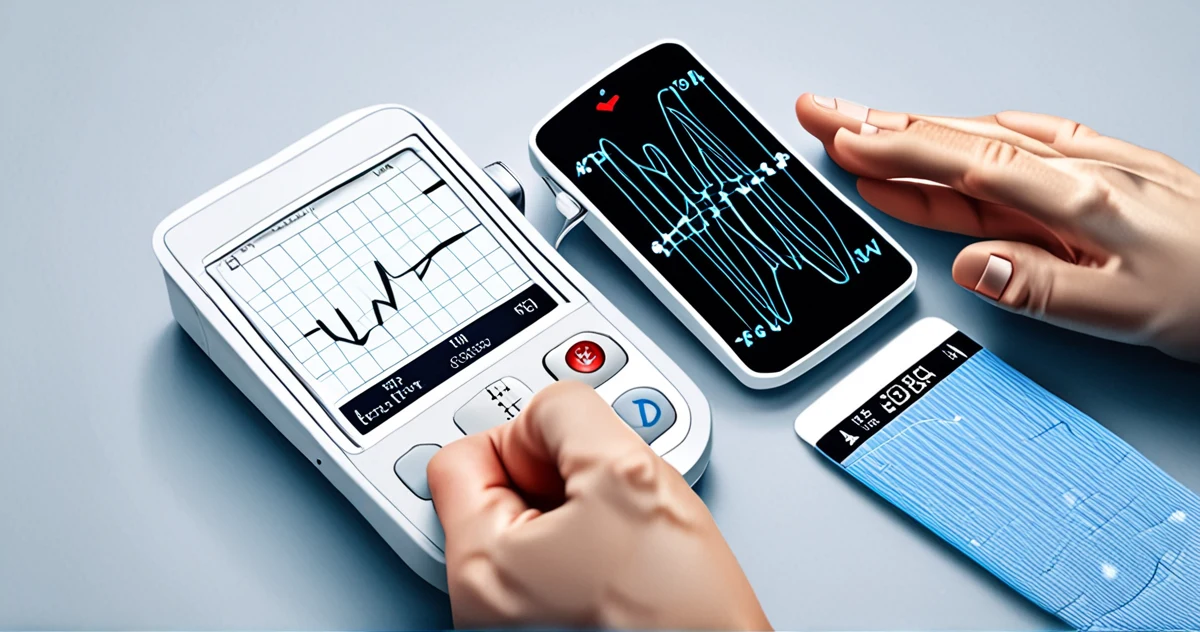
Holter vs. ECG Wearables: The Myth of Technical Obsolescence
Imagine a patient presenting with intermittent palpitations. Their resting ECG is normal. Ten years ago, the solution was clear: a traditional Holter monitor for 24 or 48 hours. Today, they might be offered a discreet adhesive patch or even a smartwatch. But is this shift towards "simpler" and "less invasive" always synonymous with "better"? The answer, as often in medicine, is more nuanced than it appears. This article separates fact from fiction in the technical comparison between traditional Holter devices and the new generation of portable ECG monitors, based on verified data and questioning certain too-quickly adopted certainties.
Diagnostic Accuracy: Can the Adhesive Patch Really Match the Holter?
Everyone seems to agree: the new devices are more convenient. But what about their ability to detect what they are looking for? A study published in Sensors compared a single-channel adhesive ECG device with traditional Holter monitoring. The results are surprising: diagnostic accuracy was similar for detecting common arrhythmias like atrial fibrillation. This validation is crucial and suggests that, for many indications, signal fidelity is not sacrificed on the altar of comfort.
> Key Insight: A validation study showed that a single-channel adhesive ECG device had diagnostic accuracy similar to traditional Holter monitoring for detecting certain arrhythmias, challenging the idea of a mandatory trade-off between convenience and reliability.
However, an important red flag emerges. The same study, and others, note that these devices "have differences" compared to the Holter in some individual patients. These discrepancies may be related to electrode placement, adhesive quality on sweaty skin, or muscle artifact. For routine diagnosis, this may be acceptable. For a complex case or a detailed pre-operative assessment, the richness of multi-channel data from a traditional Holter remains unmatched.
Duration and Patient Burden: The End of Bulky Wiring?
The main argument against the traditional Holter is its intrusiveness. Wires, a shoulder-worn box, itchy sticky electrodes... It's a burden for the patient, often cited as a factor for non-compliance. New wearables, like adhesive patches, address this problem. They are described as "less heavy and less cumbersome" than traditional Holters. A patient can shower, exercise, and sleep normally without worrying about disconnecting a cable.
But this simplicity has a technical corollary: battery life. A standard Holter records continuously for 24 to 48 hours on multiple channels. An adhesive patch with a limited battery or a smartwatch in active monitoring mode may have a much shorter lifespan or intermittent recording. The question is therefore not just "is it more comfortable?" but "is the observation window suited to the patient's symptoms?" For very rare events, an event recorder (cardiac event recorder), whether traditional or new generation, remains more relevant than short-duration continuous monitoring.
Accessibility and Data Flow: Towards More Responsive Medicine?
Here, the break is clear. Traditional Holters operate on the "store-and-forward" principle: record, return the device, analyze the data afterwards. New wearables often integrate a dimension of real-time or near-real-time telemonitoring. One study even describes a device for "real-time electrocardiographic telemonitoring". This radically changes the clinical game. An alert for a serious arrhythmia can be transmitted instantly, allowing for rapid intervention.
This connectivity also paves the way for longer-term monitoring at a potentially lower cost, as highlighted by a DAIC article mentioning "low-cost or even disposable" devices. Imagine tracking the effectiveness of an anti-arrhythmic treatment over several weeks, rather than relying on a 48-hour snapshot. This is potentially revolutionary for the management of chronic diseases.
Yet, a second red flag emerges: information overload. A constant stream of raw data, often single-channel, sent to a platform or clinician, can generate noise, false positives, and an unmanageable workload without very sophisticated triage algorithms. Technology sometimes outpaces the system's capacity to use it efficiently.
So, Is the Holter Doomed to Disappear?
The answer is no, and this is the central point of this analysis. The comparison should not be seen as a duel where a winner must emerge, but as a technical complementarity. The Mayo Clinic reminds us that the Holter is indicated when a standard ECG "does not provide enough detail about the heart's condition". It remains the gold standard for detailed, multi-channel, continuous 24-48 hour assessment.
ECG wearables, on the other hand, excel in specific niches:
- Screening and long-term monitoring for conditions like paroxysmal atrial fibrillation.
- Post-treatment or post-ablation monitoring.
- Initial assessment of infrequent symptoms, before perhaps deciding on a more comprehensive Holter.
- Real-time telemonitoring for high-risk patients.
The future, as suggested by a DAIC blog, lies in a "rise of next-generation technology" that will coexist with proven methods. The choice of device should be guided by a precise clinical question: "What am I looking for, and with what urgency do I need the information?"
Conclusion: Beyond the Hype, a Matter of Clinical Common Sense
The revolution in cardiac wearables is real, offering unprecedented convenience, accessibility, and responsiveness. Data shows their accuracy can rival the Holter for targeted indications. However, declaring the traditional Holter obsolete would be a technical and medical error. It remains a deep and robust diagnostic tool, indispensable in many contexts.
The real challenge for healthcare professionals in the digital age is not to choose a side, but to become monitoring architects. It's about knowing how to assemble the right tool – multi-channel Holter, adhesive patch, connected event monitor – based on each patient's unique clinical picture. The most advanced technology is not always the most appropriate. Innovation now lies in the intelligence of its application.
To Go Further
- Holter monitor - Mayo Clinic - Explanation of the indications and operation of the traditional Holter monitor.
- Movement Toward Simpler, Wearable Cardiac Monitoring | DAIC - Article on the trend towards simpler, less expensive wearable devices.
- BLOG: Moving Beyond Holter ECG: The Rise in Next Generation Technology - Perspective on the evolution of cardiac monitoring technologies.
- Comparison of Continuous ECG Monitoring by Wearable Patch ... - Study comparing the diagnostic accuracy of an ECG patch with a conventional monitoring device.
- A wearable real-time telemonitoring electrocardiogram device ... - Research on a portable real-time telemonitoring ECG device and its potential differences from the Holter.
- Validation of Adhesive Single-Lead ECG Device Compared with ... - Scientific validation study of a single-channel adhesive ECG device.
- Wearable Devices in Cardiovascular Medicine | Circulation Research - Academic review on the use and impact of wearable devices in cardiology.