Gopher, Archie and AltaVista: The Overlooked Technical Legacy That Still Shapes Our Search
Imagine a world where every Internet search returns a raw list of results, without sorting or relevance. This was the reality before Google, when technologies like Gopher and Archie dominated. These pre-web systems, often relegated to the status of historical curiosities, actually defined technical principles that persist in today's search infrastructures. Their legacy is not just a footnote in Internet history, but a series of architectural choices that continue to influence how we organize and access digital information.
For digital professionals, understanding these technical foundations offers more than a history lesson. It reveals why certain infrastructure decisions persist despite technological revolutions, and how the constraints of the 1990s shaped paradigms still visible today. This article explores three overlooked technical aspects of these pre-web systems and their lasting influence on the modern search ecosystem.
1. The Gopher Paradox: An Elegant Protocol That Failed Against the Web's Raw Simplicity
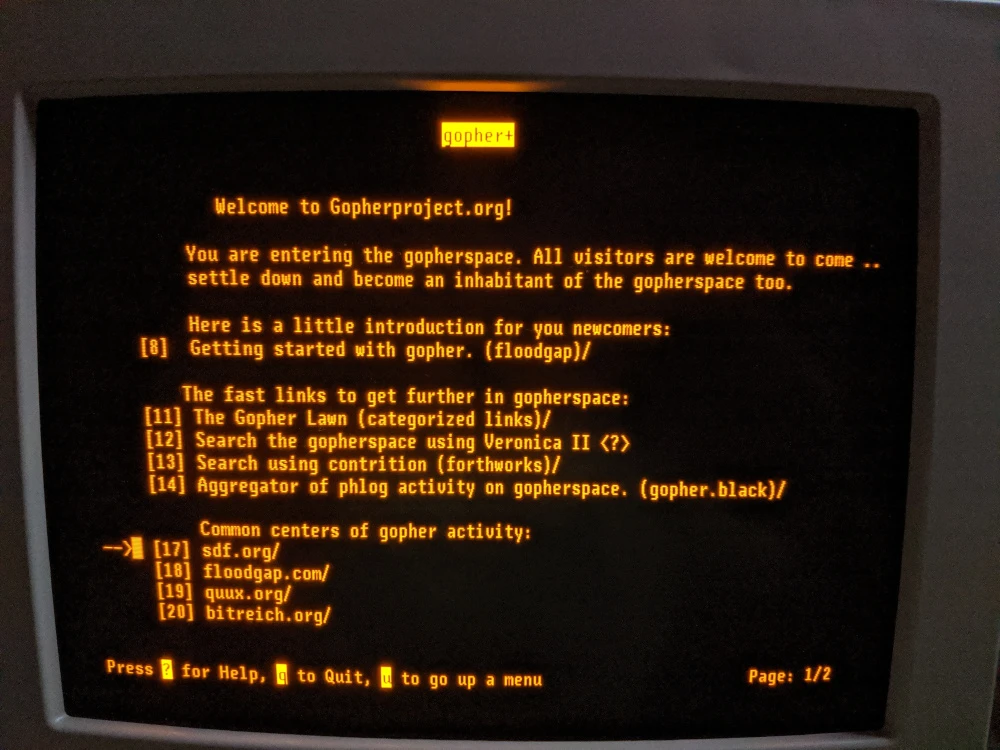
The Gopher protocol, developed at the University of Minnesota in the early 1990s, represented a structured, hierarchical approach to information access. Unlike Tim Berners-Lee's nascent Web, Gopher organized documents into nested menus, creating a more orderly but less flexible navigation experience. As Wikipedia describes, Gopher was designed to "distribute, search, and retrieve documents in IP networks."
> Technical analogy: Gopher functioned like a library with a rigid classification system, while the Web resembled more of a flea market where links created organic but chaotic connections.
Gopher's relative failure against the Web illustrates a fundamental principle: in information access technologies, flexibility often triumphs over order. The Web triumphed not because it was technically superior, but because its hyperlink model allowed unpredictable and creative connections that Gopher's rigid structure could not accommodate.
Yet, Gopher's legacy persists in modern concepts:
- Hierarchical menu systems found in certain administration interfaces
- Category-based organization that foreshadowed web taxonomies
- Separation between content and presentation that Gopher imposed by nature
2. Archie and the First Indexers: The Birth of the "Crawl" Concept
Archie, created in 1990, is often considered the first Internet search engine. Its operation was radically different from modern engines: it indexed filenames available on public FTP servers, thus creating a searchable database of resources. According to the search engine timeline on Wikipedia, Archie marks the beginning of an era where information discovery no longer depended solely on word-of-mouth or manual lists.
Archie's technical mechanism foreshadowed essential concepts:
- Automated indexing of distributed resources
- Creation of searchable databases from disparate sources
- Distinction between name-based search and content-based search
A Quora user remembers the AltaVista era, Archie's spiritual successor: "Alta Vista dumped everything on the Web at you, without any particular order. At first, it amazed people - 'I can see what's on the Web!'" This description captures the essence of the first generation of search engines: raw exhaustiveness rather than relevance.
Archie's technical legacy is particularly visible in:
- Modern indexing robots that crawl the web
- File metadata as a search element
- The idea that a centralized index can make a decentralized network navigable
3. The Invisible Infrastructure: How 1990s Constraints Defined Lasting Architectures
Pre-web systems operated under severe technical constraints: limited bandwidth, low computing power, and expensive storage. These limitations forced developers to create remarkably efficient architectures whose principles persist today.
The Google case is revealing. As noted in a presentation on modern enterprise applications, "Google uses Go extensively for a wide range of things, from our indexing platform that powers Google Search to infrastructure..." This technological continuity shows how the fundamental needs of web indexing - efficiency, parallelization, large-scale data management - persist despite changes in languages and infrastructures.
Three architectural legacies deserve attention:
- Separation between crawling and indexing: already present in systems like Archie, this distinction allows separating data collection from its processing and querying
- Lightweight exchange formats: Gopher used simple text protocols, foreshadowing modern REST APIs and JSON
- Resilience through distribution: pre-web systems had to function on unreliable networks, forging architectural mindsets that resonate with current microservices and cloud computing
The Paradoxical Legacy: What Modern Technologies Have Kept... and What They Have Deliberately Abandoned
The evolution of search technologies presents a fascinating paradox. On one hand, fundamental concepts like indexing, crawling, and searchable databases have persisted through technological revolutions. On the other hand, entire approaches like Gopher's hierarchical navigation have been largely abandoned in favor of more flexible models.
This technical legacy creates a permanent tension in the development of modern search systems. As noted in an academic article on search engine regulation, "since the creation of the first pre-Web Internet search engines in the early 1990s, search engines have..." developed increasing complexity while retaining unchanged basic functions.
> Key insight: The true innovation in search engines has not been the invention of fundamental concepts like indexing, but their scaling to levels unimaginable in the 1990s, while adding layers of algorithmic intelligence.
Conclusion: Why This Technical Legacy Still Deserves Our Attention
Pre-web technologies like Gopher, Archie and their immediate successors are not mere relics. They represent alternative branches in Internet evolution, each with its technical strengths and weaknesses. Their study reveals that:
- Technical constraints forge lasting architectures: 1990s limitations produced designs that persist in adapted forms
- Flexibility often triumphs over order: the Web's success against Gopher shows the value of systems that allow unexpected connections
- Invisible infrastructure persists: fundamental layers of indexing and crawling evolve but do not disappear
For digital professionals, this historical perspective offers more than academic curiosity. It reminds us that the systems we build today will likely bear the marks of our own technical constraints - constraints that might seem as archaic in thirty years as 56k modems seem to us today. As a developer suggests about Web Components, "in 10 years, it's possible that no one uses [current frameworks] but a Web Component will still be there with the..." - a reminder that some technical layers have surprising longevity.
The next time you use a modern search engine, remember that beneath its sophisticated interface and complex algorithms still beats the heart of simpler systems that made navigating the informational chaos of the Internet possible.
To Go Further
- Gopher (protocol) - Wikipedia) - Description of the Gopher protocol and its operation
- Timeline of web search engines - Wikipedia - Complete timeline of search engines from Archie
- Before Google, how inaccurate were search engines? What was Alta Vista like - Quora - Testimony about the user experience of early search engines
- Modern enterprise applications with go go day 2025 | spf13 - Use of Go in modern search infrastructure
- Regulating Search Engines: Taking Stock and Looking Ahead - Academic perspective on search engine evolution
- A short history of the Web | CERN - Context on Web development against alternative technologies
- Web Components Are Not the Future - DEV Community - Reflection on web technology longevity