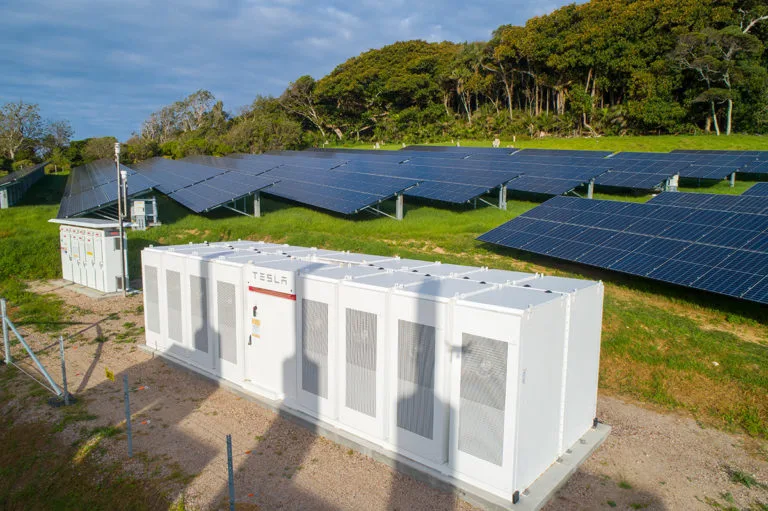
On Flinders Island, in Tasmania, almost all electricity came from diesel generators. The remoteness from the Australian mainland made each fuel delivery costly, and logistical failures weighed on service continuity. The installation of a system combining solar panels and batteries changed the situation: according to Sunlithenergy, dependence on diesel there has fallen sharply.
This result is not an isolated case. From islands in the Philippines to the Maldives, hybrid microgrids combining photovoltaics, batteries and sometimes wind power are emerging as a credible alternative to aging diesel plants. For digital professionals who design, deploy or supervise these infrastructures, feedback provides concrete lessons.
This article analyzes how a small island can reduce its diesel consumption through solar and storage, drawing on documented case studies and recent research.
> Key points
> - Hybrid photovoltaic-wind-diesel-battery systems can reduce diesel consumption by more than 60% while maintaining reliability.
> - Real cases such as Flinders Island or Huraa Island show that the transition is technically viable.
> - Seasonal storage, particularly via green hydrogen, complements batteries for islands with high renewable penetration.
> - The islands of the Philippines offer major economic potential for these hybrid solutions.
The energy paradox of small islands
Small, non-interconnected islands have a singular energy profile. Their isolation rules out any connection to a continental grid, requiring local production. Historically, diesel prevailed: generators are modular, start quickly and require relatively simple infrastructure. But this simplicity comes at a cost.
Fuel must be imported by boat, with delays and weather hazards. The volumes consumed are small on the scale of an island, which drives up the unit price. Engine maintenance, often carried out by traveling technicians, weighs on budgets. Finally, CO2 and particulate emissions are proportionally high.
According to the article published in Ijeepse, many small islands still depend on costly diesel plants. This dependence hinders local economic development and makes supply vulnerable to delivery disruptions.
The challenge is to introduce renewable sources without compromising grid stability. This is where hybrid systems come into play.
The building blocks of a hybrid microgrid
A hybrid microgrid generally combines several generation and storage sources, managed by an energy management system. Typical components include:
- Photovoltaics (PV): main source during the day, almost zero operating cost, but variable production depending on sunshine.
- Wind: complementary to solar, especially in windy latitudes, but requires a sufficient wind resource.
- Lithium-ion or other batteries: short-term storage to smooth fluctuations and shift solar production to hours without sun.
- Diesel generator: backup and supplementary power, sized for demand peaks or long cloudy periods.
- Energy management system (EMS): algorithm that optimizes resource use in real time, minimizes diesel and protects the battery.
According to a study published in ScienceDirect on the small islands of Southeast Asia, PV-wind-diesel-battery systems can reduce diesel consumption by more than 60% while maintaining grid reliability. These figures, from case studies in the Philippines and Malaysia, illustrate the potential.
To understand how these elements interact, let us take a hypothetical scenario. Imagine an island of 500 inhabitants, with no connection to the mainland. Every month, a tanker brings fuel oil. On a cloudy, windless day, solar produces little and wind is at a standstill. Without a battery, diesel would have to take over entirely. With a properly sized battery, the energy stored during the previous sunny hours covers the demand, and the generator starts only if necessary. This is the principle of "diesel-off": the generator stays off as often as possible.
| Component | Main role | Impact on diesel |
|-----------|----------------|----------------------|
| Solar panels | Daytime production | Reduces the need for fuel during the day |
| Wind turbines | Complementary production | Reduces the need during windy periods |
| Batteries | Smoothing and shifting | Makes it possible to turn off diesel during peaks |
| Diesel generator | Backup and supplementary power | Consumption minimized by the EMS |
| EMS | Optimization | Decides when to start/stop diesel |
Case study: Huraa Island, a Maldivian laboratory
The Maldives, an archipelago of nearly 1,200 islands, relies heavily on diesel for its electricity. Each inhabited island operates as an isolated microgrid. Huraa Island, a small island in Kaafu Atoll, was the subject of an optimization analysis published in ScienceDirect.
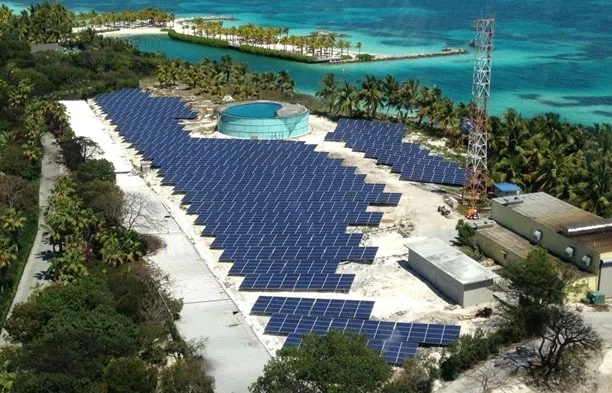
The study modeled several combinations of renewable sources and storage to determine the most efficient configuration in terms of cost and reliability. The researchers integrated solar photovoltaics, wind, batteries and diesel into a single system. The goal: to minimize the levelized cost of electricity (LCOE) while guaranteeing a continuous supply.
Although the detailed results are not public in the summary consulted, the approach is representative of current work. It shows that each island has its own profile: sunshine, wind, load curve, space constraints. An optimal configuration for Huraa would not be directly transferable to an island in the Philippines or the Mediterranean.
This type of analysis is crucial for decision-makers. It makes it possible to size equipment as accurately as possible, avoiding overinvestment in batteries that are too large or undersizing that would leave diesel running too often.
The Philippines, a vast experimentation ground
The Philippines has hundreds of inhabited islands, many of which are powered by diesel plants owned by electric cooperatives or the national operator. A study published on ResearchGate and covered by the SDEWES journal analyzed the energy transition of these small island grids toward hybrid solar photovoltaic-battery-diesel systems.
The authors conclude that the economic potential is considerable. Replacing part of the diesel with solar and batteries would significantly improve the economics of existing grids while reducing emissions. They stress, however, that policy implications are decisive: without an appropriate regulatory framework, investments will remain timid.
The article also mentions a pilot project launched in 2011, whose electricity production increased after adding a solar component to a diesel system. This type of demonstration paved the way for broader deployments.
For digital professionals, the Philippines offers a textbook case on the importance of monitoring systems. Managing dozens of dispersed microgrids requires a centralized platform capable of reporting production data, battery status, fuel consumption and alarms. IoT technologies and digital twins find a direct application here.
Beyond batteries: green hydrogen and seasonal storage
Lithium-ion batteries excel at short-term storage, from a few hours to a few days. But on an island subject to marked seasonal variations — for example, a rainy season that reduces sunshine for several weeks — they may prove insufficient. This is where complementary solutions come in.
A study published by MDPI describes the case of a small Mediterranean island where seasonal green hydrogen storage was used to complement batteries. Hydrogen, produced by electrolysis from surplus summer solar power, is stored and then converted back into electricity via a fuel cell during periods of low renewable production.
This battery-hydrogen pairing meets a need for resilience over several weeks, or even several months. The cost of green hydrogen remains high, but it is gradually decreasing. For some islands, this option is becoming competitive against diesel imports, especially when the carbon price is included.
The table below summarizes the differences between battery storage and hydrogen:
| Criterion | Lithium-ion battery | Green hydrogen |
|---------|----------------------|----------------|
| Storage duration | Hours to days | Weeks to months |
| Round-trip efficiency | High (80-90%) | Moderate (30-40%) |
| Investment cost | Moderate, decreasing | High, slowly decreasing |
| Technological maturity | Proven | Demonstrations |
| Typical use | Daily smoothing | Seasonal reserve |
The technical and economic challenges to overcome
Despite the successes, the transition to hybrid microgrids is not without obstacles. Sunlithenergy, in its engineering guide on island BESS systems, recalls that design and sizing are critical steps. Poor battery sizing can lead to premature degradation or unnecessary costs.
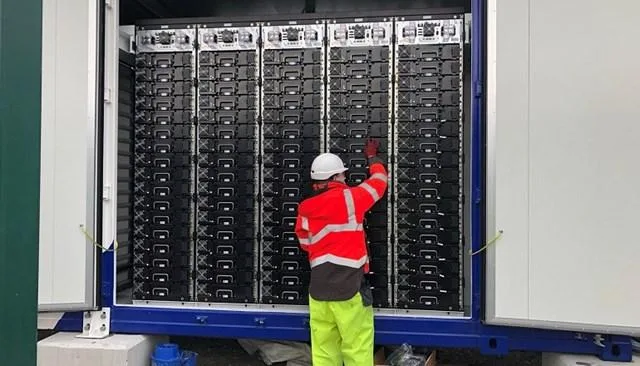
The main challenges include:
- Grid stability: on a small island grid, inertia is low. The massive integration of power electronics (inverters) requires fine-tuning to avoid frequency variations.
- Managing intermittency: short-term weather forecasts become essential for planning diesel start-up if necessary.
- Maintenance and local skills: batteries and control systems require trained technicians, who are often scarce on the islands.
- Financing: the initial cost of a hybrid system remains high, even if the total cost of ownership over 20 years is often lower than diesel. Financing models (performance contracts, battery leasing) must adapt.
- Social acceptance: residents must understand how the system works to avoid behavior that overloads the grid.
The available case studies show that these challenges are surmountable. Flinders Island has demonstrated that a well-designed system can greatly reduce dependence on diesel. Analyses in the Philippines indicate that the overall economics are favorable, provided that public policies support the initial investment.
What this changes for digital professionals
For digital players — developers, data scientists, system architects, project managers — island microgrids open up a concrete field of applications.
First, data collection and analysis are at the heart of optimization. Each panel, inverter, battery and generator produces operating data. Machine learning algorithms can forecast solar production from weather data, anticipate demand and optimize battery charge/discharge to minimize diesel.
Next, remote monitoring is essential. Islands are remote; sending a technician is expensive. A robust IoT platform makes it possible to monitor system status, receive alerts and even perform remote restarts. User interfaces must be simple for local operators with limited specialized skills.
Finally, cybersecurity becomes critical. An isolated microgrid can be an easy target if it is connected to the Internet without adequate protections. Digital professionals must integrate encryption, authentication and network segmentation mechanisms from the design stage.
These aspects are not detailed in the sources provided, but they follow logically from the architecture of the systems described. Studies on Huraa Island or the Philippines focus on the energy dimension, but their actual implementation necessarily involves an advanced software layer.
Conclusion
Reducing diesel consumption on small islands is no longer a utopia. Projects such as the one on Flinders Island show that solar and batteries can transform an isolated microgrid. Analyses conducted in the Maldives, the Philippines and Southeast Asia quantify the potential: more than 60% reduction in diesel, substantial savings and environmental gains.
For digital professionals, this sector offers concrete opportunities. Designing energy management systems, developing predictive algorithms, securing communications: all of these are directly transferable skills.
The question that now arises is that of scaling up. How many islands in the world could benefit from such solutions? And how can deployment be accelerated without repeating the mistakes of the first projects? The accumulated feedback, documented by the cited sources, outlines a promising trajectory. It remains to be followed.
Further reading
- Sunlithenergy — Comprehensive engineering guide on BESS systems for island grids, with case studies including Flinders Island.
- ScienceDirect - Optimal analysis of a hybrid renewable power system for a remote island — Optimization analysis for Huraa Island (Maldives) combining diesel, solar, wind and batteries.
- MDPI - Future Directions of Hybrid Off-Grid Renewable Energy Systems — Article on future directions for hybrid off-grid systems, including seasonal storage with green hydrogen.
- ScienceDirect - Hybrid renewable energy systems for small islands in Southeast Asia — Case study in the Philippines and Malaysia showing diesel reductions of more than 60%.
- ResearchGate - Energy Transition from Diesel-based to Solar Photovoltaics-Battery-Diesel Hybrid System-based Island Grids in the Philippines — Techno-economic analysis of the energy transition potential on island grids in the Philippines.
- SDEWES - Energy Transition from Diesel-based to Solar Photovoltaics-Battery — Published version of the study on the transition from diesel power plants to hybrid systems in island grids in the Philippines.
- Ijeepse - Hybrid Power System Optimization for Cost and Emission Reduction — Article on optimizing hybrid systems to reduce costs and emissions, mentioning a pilot project since 2011.