
Introduction

The Fermi Paradox, this famous question about the absence of conclusive evidence of intelligent extraterrestrial life despite the high probability of its existence, continues to haunt the scientific community. While the universe contains billions of stars and potentially habitable planets, the absence of contact or detection remains a profound mystery.
For digital and tech professionals, this question is not just a philosophical curiosity: it touches on the limits of our detection technologies, large-scale data analysis, and the challenges of interstellar communication.
In this article, we explore the technical reasons that could explain why we haven't found aliens yet, based on recent analyses and scientific perspectives.
The Foundations of the Fermi Paradox
The Fermi Paradox rests on an apparent contradiction: on one hand, the universe seems conducive to the emergence of life, with an immense number of stars and planets; on the other, we have no tangible evidence of extraterrestrial civilizations.
As Wikipedia summarizes: "The Fermi Paradox is the discrepancy between the absence of conclusive evidence of advanced extraterrestrial life and the apparently high probability of its existence."
> "The Fermi Paradox is the discrepancy between the absence of conclusive evidence of advanced extraterrestrial life and the apparently high probability of its existence." - Wikipedia
This contradiction raises fundamental questions about our place in the universe and the limits of our ability to observe and communicate.
Technological Limitations of Detection
Our current instruments, although sophisticated, might be insufficient to detect extraterrestrial signals. SETI (Search for Extraterrestrial Intelligence) research faces several major technical obstacles:
Sensitivity of Radio Telescopes
- Limited range: Even the most powerful radio telescopes, like the Very Large Array, can only capture relatively close or very intense signals
- Reduced spatial coverage: We can only monitor a tiny fraction of space simultaneously
- Temporal resolution: Observations are often time-limited, potentially missing intermittent signals
Frequency Band Problems
- Restricted search ranges: We mainly search in specific ranges, but advanced civilizations might use communication technologies we don't yet understand
- Technological evolution: Extraterrestrial communication methods might have evolved beyond our current detection capabilities
Terrestrial Interference
- Radio noise generated by our activities: Human communications, satellites, and other terrestrial sources complicate distinguishing extraterrestrial signals
- Data filtering: Separating useful signals from background noise represents a major technical challenge
As Centauri Dreams notes in "SETI Odds and Ends," "we hope to find life forms that have survived," which implies that our search is biased by our expectations and technological capabilities.
Communication and Distance Barriers
Interstellar communication is hindered by fundamental challenges related to cosmic distances and potential technological differences.
Colossal Interstellar Distances
- Communication latency: Even at the speed of light, a message to a nearby star would take years to arrive, and the response just as long
- Galactic scale: Our galaxy measures about 100,000 light-years in diameter, making communication with distant civilizations extremely slow
- Time window: Civilizations might exist at different times, reducing possibilities for simultaneous communication
Technological Incompatibilities
- Different communication methods: Aliens might use technologies radically different from ours
- Divergent time scales: Their perception of time and communication cycles might be incompatible with ours
- Asynchronous evolution: Technological development might follow different trajectories in different civilizations
As an article on Againstprofphil suggests, "we haven't been able to communicate with aliens" partly because of these barriers. Civilizations might exist, but be beyond the reach of our current communication means.
Key points to remember about communication barriers:
- Interstellar distances make communication extremely slow and difficult
- Our technologies might not match those used by potential aliens
- Absence of evidence is not evidence of absence; it may simply reflect our current limitations
Concrete SETI Projects and Detection Technologies
Examples of Current SETI Projects
- Breakthrough Listen: $100 million initiative using Green Bank and Parkes radio telescopes
- Allen Telescope Array: Network of 42 radio antennas specifically dedicated to SETI research
- SETI@home: Distributed computing project analyzing radio telescope data
Advanced Detection Technologies
- Optical interferometry: Combining multiple telescopes to improve resolution
- High-precision spectroscopy: Analysis of exoplanet atmospheres to detect biosignatures
- Technosignature search: Detection of evidence of advanced technology rather than intentional communication
Implications for Digital Professionals
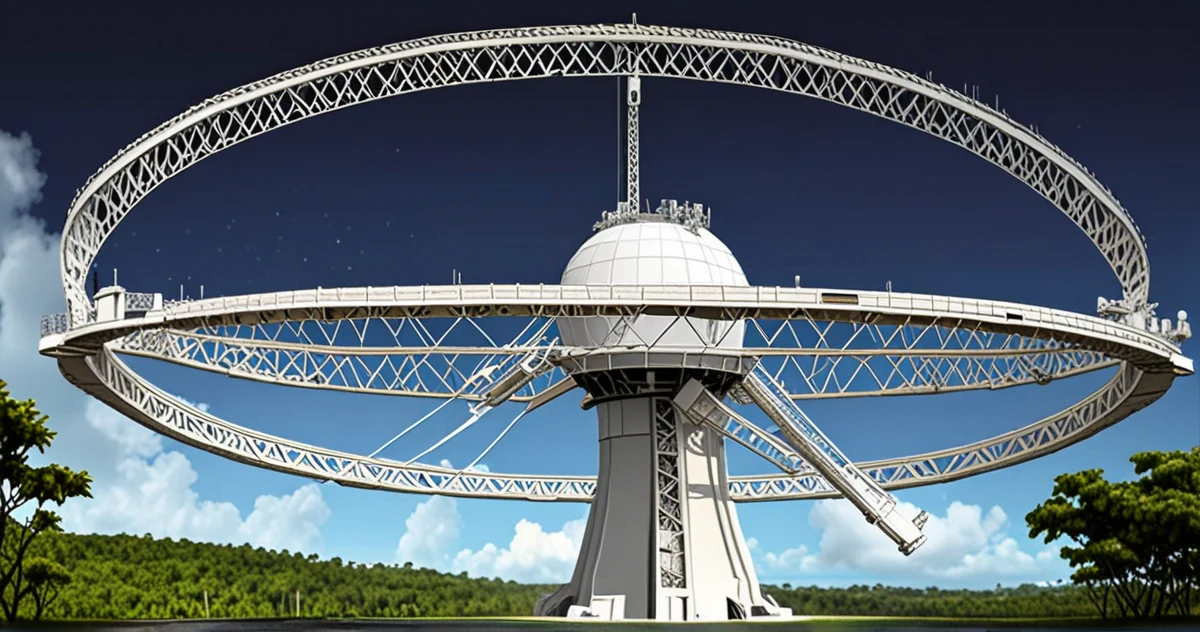
For technology and data analysis experts, the Fermi Paradox offers valuable lessons on several technological fronts.
Big Data Processing and Artificial Intelligence
- Analysis of massive volumes: SETI projects generate enormous amounts of data requiring advanced algorithms
- Machine learning: AI could help identify weak signals or complex patterns in cosmic noise
- Intelligent filtering: Developing systems capable of effectively distinguishing potential signals from background noise
Detection Technology Development
- More sensitive sensors: Investing in technologies like optical interferometers to extend our detection range
- New approaches: Exploring alternative detection methods beyond radio waves
- Instrument collaboration: Combining different types of telescopes and detectors for more complete coverage
Collaboration and Infrastructure
- International cooperation: Pooling resources between space agencies and research institutes, similar to open source projects
- Surveillance networks: Developing distributed systems to simultaneously monitor different sky regions
- Data standards: Establishing common protocols for sharing and analyzing research data
A useful analogy: searching for aliens is like searching for a needle in a cosmic haystack; our current tools might not be fine enough to find it.
Technical Solutions and Future Approaches
Several innovative approaches could help us overcome current limitations in our quest for extraterrestrial life.
Ongoing Technological Improvements
- Next-generation telescopes: Instruments with improved sensitivity and resolution
- Advanced analysis algorithms: Machine learning techniques for SETI data processing
- Multi-wavelength monitoring: Extending searches beyond the radio spectrum
Expanded Search Strategies
- Technosignature search: Detection of evidence of advanced technology rather than intentional communication
- Systematic monitoring: Continuous observations of targeted sky regions
- Multi-messenger approach: Combination of different detection methods
Comparison Table of Detection Methods
| Method | Advantages | Limitations | Example Projects |
|---------|-----------|-------------|---------------------|
| Radio SETI | Long-distance detection | Terrestrial interference | Breakthrough Listen |
| Optical search | High resolution | Sensitivity to atmospheric conditions | Optical SETI |
| Technosignatures | Indirect detection | Difficulty of interpretation | Megastructure search |
| Biosignatures | Direct evidence of life | Limited to nearby planets | James Webb Telescope |
Practical Applications of SETI Technologies
The technologies developed for SETI research find concrete applications in other fields:
Advanced Signal Processing
- Filtering algorithms: Used in telecommunications and speech recognition
- Pattern detection: Applied in medicine for medical image analysis
- Source separation: Used in acoustics and audio processing
Distributed Computing Infrastructure
- Computing networks: Reusable models for climate and pharmaceutical research
- Massive data storage: Solutions adaptable to other scientific fields
- International collaboration: Frameworks for global research projects
Perspectives and Final Reflections

In conclusion, the Fermi Paradox remains a fascinating enigma, but technical limitations largely explain why we haven't found aliens yet. Our detection and communication technologies, although impressive, are probably rudimentary on a galactic scale.
As Quora points out, "there is a very, very good chance that extraterrestrial life exists," but we may need to be patient and innovate to discover it.
For tech professionals, this means:
- Continuing to push the boundaries of digital technology and data analysis
- Developing more sensitive technologies and smarter algorithms
- Promoting international collaboration in space research
The quest for answers is not vain; it motivates innovation and reminds us of the immense technological challenges to overcome. The Fermi Paradox teaches us humility in the face of the cosmic scale while stimulating our scientific curiosity.
Going Further
- Againstprofphil - Article on a neo-Kantian solution to the Fermi paradox
- Wikipedia - Detailed page on the Fermi paradox
- Reddit - Discussion on the absence of evidence for alien visitation
- Reddit - Debate on fundamental ideas in science fiction
- Openthefuture - Reflections on the Fermi paradox
- Quora - Questions about the existence of extraterrestrial life
- Quora - Discussions about reasons for the absence of contact
- Centauri Dreams - Article on various aspects of SETI