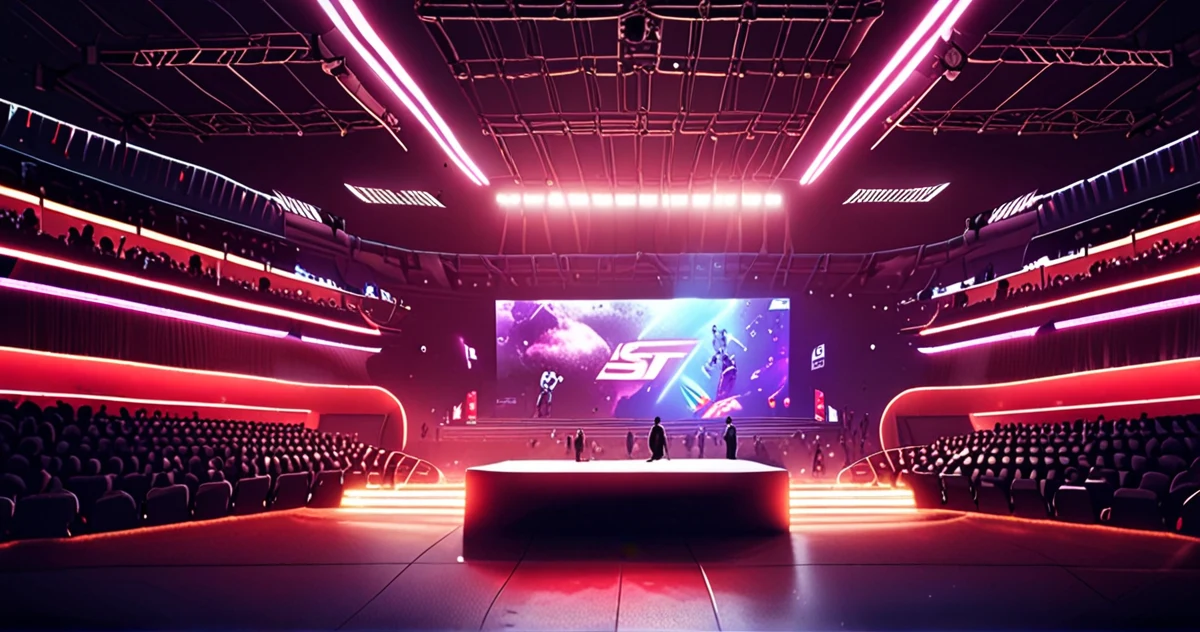
Imagine a spectator in an esports stadium in 2026. They are not just watching a giant screen. On their AR glasses, real-time game statistics float above the arena. In their hand, a device vibrates to the rhythm of in-game gunfire. This fusion of physical and digital is no longer science fiction, but the immediate horizon of electronic competition venue design.
Why is this evolution critical? Because traditional esports, broadcast solely on screen according to SIGGRAPH observations, are reaching their limits in terms of emotional engagement. Live spectators now seek more than passive viewing. They want to feel the action, interact with the game environment, and experience something that justifies their physical travel. This article explores how immersive technologies like augmented reality (AR) and haptic feedback are being integrated into the very DNA of new esports stadiums, transforming both the spectator experience and the economic models of organizers.
From Giant Screen to Hybrid Arena: What Architecture for Immersion?
How to design a space that serves both as a stage for virtual competitions and a platform for augmented experiences? The answer no longer lies solely in acoustics or visibility, but in the systemic integration of digital layers. Sources like Draw & Code and TDK emphasize that integrating AR into live broadcasts or the stadium environment is a major trend. This translates concretely into:
- Oversized network infrastructure: To support massive, low-latency AR data streams for thousands of simultaneous spectators.
- Interactive surfaces: Walls, seats, or even the floor can become interfaces to display contextual AR information or react to in-game action.
- Modular design: Inspired by trends in experiential vehicle design for 2026 reported by Craftsmenind, spaces must be reconfigurable to adapt to different games and experience formats, shifting from a fighting tournament to a racing simulation.
The goal is to create, as Craftsmenind describes, "fully immersive mobile experiences" within a fixed venue, where the spectacle transcends the screen to invade the spectator's physical space.
Haptic Feedback: Making the Stands Vibrate, Not Just the Controllers
If AR changes what the spectator sees, haptic feedback revolutionizes what they feel. But how to translate the vibrations of a game controller to the scale of a stadium? The technology, as demonstrated by the Metapunch X project presented at SIGGRAPH 2026, is evolving rapidly. Metapunch X is described as a "met"-type haptic feedback esports game that integrates physical interaction (exertion) in extended reality (XR) with a spectacular multi-screen setup.
For the stadium audience, this opens several avenues:
- Haptic seats: Actuators, like TDK's PiezoHapt™ technology cited as an example, could be integrated into seats to transmit impacts, explosions, or vibrations from the virtual playing field.
- Lightweight wearable devices: Bracelets or gloves distributed at the entrance, synchronized with the action, offering customizable tactile feedback (e.g., a light pulse for damage taken by the favorite team).
- Environmental effects: Using sound systems and even building structures to create low-frequency vibrations during key match events, creating a collective physical sensation.
As noted in the SIGGRAPH article, current esports games are "only broadcast on screen." Introducing live haptics breaks this sensory barrier, creating a direct physical link between the digital action and the spectator's body. A specialized architect might say: "We are no longer designing a building to host a show, but a collective sensory body to embody it."
Active Spectator or Social Avatar? Redefining the Audience's Role
With these technologies, the spectator shifts from witness to participant in the atmosphere. But how far can this interaction go? Research points towards increasing personalization of the experience. Through a smartphone app or AR glasses, a spectator could:
- Choose their information "layer": display statistics for a specific player, see predictive trajectories, or activate alternative audio commentary.
- Interact with game elements: vote for the "player of the moment," influence light visual effects in the arena (colors, lights), or participate in community mini-games during breaks.
- Share their experience: immersive technologies, as highlighted in a tandfonline article, increase user participation. A spectator could share their personalized AR view on social media, creating derivative content and visibility for the event.
This evolution responds to a demand identified by ScienceDirect, where consumers of traditional sports are also often e-sports players. They come to the stadium wanting an experience as rich and interactive as the one they have in front of their screen at home, but amplified by the collective presence.
Challenges and Perspectives: Beyond the "Gadget," Towards a New Model
Integrating these technologies is not without challenges. Cost, technical complexity, standardization between different games and publishers, and managing the privacy of data generated by interactions are major obstacles. Furthermore, it is necessary to avoid technology becoming a distracting gadget rather than an emotion amplifier.
However, the perspective is powerful. In 2026, the successful esports stadium may no longer be the one with the largest capacity, but the one offering the most memorable and customizable sensory and interactive experience. It becomes a hub where competitive gaming, social entertainment, and technological innovation converge. As summarized in TDK's analysis, these technologies are "vital for competitors and spectators." By integrating them into the very architecture of the venue, promoters are no longer selling a ticket to a match, but access to a unique experiential ecosystem.
The race is on. The first stadiums designed with these principles from the drawing board will emerge by the end of the decade. They will not replace home streaming experiences, but will offer a premium, social alternative that only physical presence, augmented by digital, can provide. Immersion will no longer be confined to the player's VR headset; it will become the air breathed by the entire audience.
To Go Further
- SIGGRAPH 2026 Immersive Pavilion - Presentation of the SIGGRAPH 2026 conference immersive pavilion, discussing the limits of current esports broadcasts.
- Draw & Code - Sports - Analysis of AR and VR integration in live sports broadcasts and stadiums.
- TDK - Immersive Esports - Examination of the role of technology, particularly haptic feedback, in immersive competitive gaming.
- Craftsmenind - Top Trends in Experiential Vehicle Design for 2026 - Trends in experiential design, relevant for modular and immersive space design.
- ACM Digital Library - Metapunch X - Research article presenting Metapunch X, an esports game with haptic feedback and physical interaction.
- ScienceDirect - Projecting the future of the top-tier sports media product - Study on the future of sports media products, including the link between traditional sports and e-sports.
- tandfonline - Long Live the Metaverse - Analysis of the potential of the metaverse and immersive technologies to increase user participation.