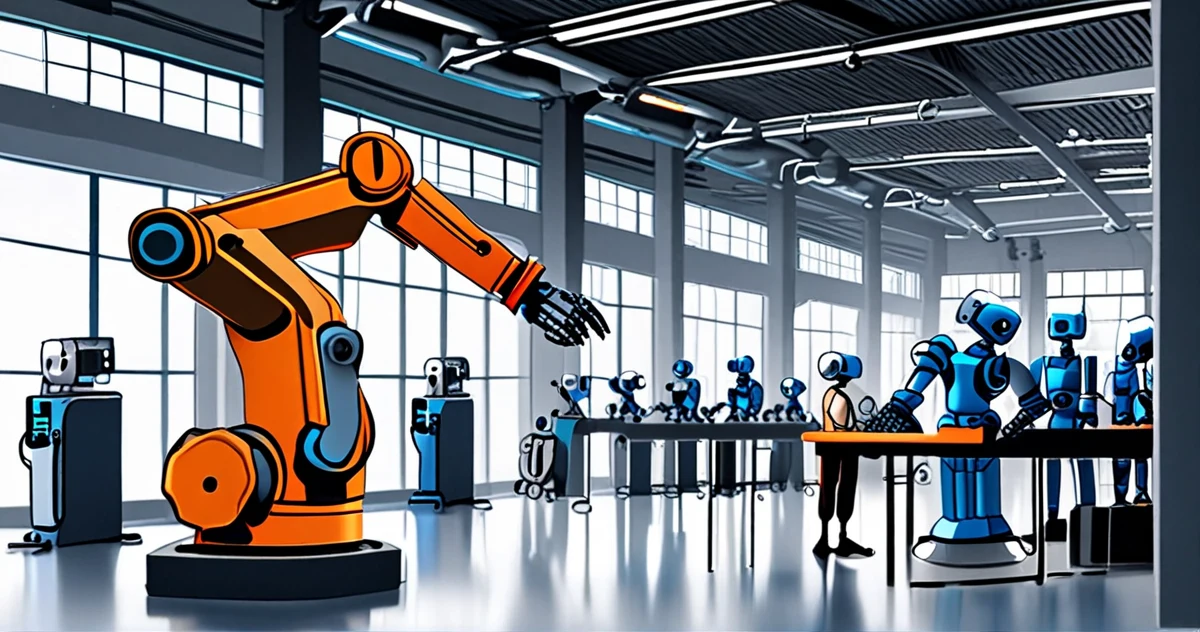
Imagine a factory worker who, instead of repeating strenuous movements, programs a robotic arm to assemble delicate parts, while supervising quality in real time using a digital twin. This scenario is no longer science fiction, but the emerging reality of workshops where cobots, or collaborative robots, are transforming human work rather than eliminating it. While traditional automation isolated machines behind safety barriers, a new generation of robots designed to physically interact with humans is redrawing production lines and, most importantly, job descriptions.
The fear that robots will steal jobs is a persistent narrative, but it misses a more subtle and promising evolution. Cobots are not replacements; they are teammates. Their integration creates a human-machine symbiosis that values unique human capabilities – judgment, adaptability, complex problem-solving – while automating repetitive, dangerous, or ergonomically harmful tasks. For professionals in industry and digital fields, understanding this transition is not an option, but a necessity to anticipate the skills of tomorrow and seize the career opportunities it generates.
This article explores how the advent of cobots in manufacturing catalyzes the creation of new professional roles. We will examine the nature of this collaboration, the hybrid positions emerging, and the implications for training and work organization at the dawn of Industry 5.0.
Human-Machine Symbiosis: From Concept to Production Line
Collaboration between humans and robots marks a turning point from the rigid automation of past decades. Cobots are designed with intrinsic safety features, such as force and speed sensors, which allow them to work side by side with operators without requiring costly and cumbersome protective cages. As noted in an article from Robotics Tomorrow, this evolution toward symbiosis is at the heart of the Industry 5.0 vision, which emphasizes collaboration and personalization rather than mere cost optimization.
This physical proximity allows for a more fluid and dynamic division of labor. A cobot can, for example, hold and position a heavy part with millimeter precision while a technician performs complex wiring or visual inspection. This interaction goes beyond simple coexistence; it creates a partnership where each actor does what they do best. The human brings dexterity, contextual perception, and improvisational ability, while the robot provides constant force, perfect repeatability, and resistance to fatigue. Research published on ScienceDirect highlights that this phase has ushered in an era of more interactive and responsive robotic behaviors, facilitating joint work and machine instruction by humans.
The Emergence of New Hybrid Professional Profiles
The integration of cobots is not limited to adding a tool to the line; it radically transforms the required skills. Rather than making positions obsolete, it enriches them and gives rise to new ones, at the intersection of mechanics, electronics, programming, and human sciences.
- The Cobotic Technician / Collaborative Operator: This is the most immediate role. It is no longer just about pressing a button, but about configuring, supervising, and interacting in real time with the cobot. This operator must understand the basics of programming by demonstration (where the robot is physically guided to learn a task), interpret its sensory feedback, and perform simple troubleshooting. They become the "pilot" of the human-machine team.
- The Cobotic Solutions Integrator: This more technical profile is crucial for deployment. They design and implement collaborative work cells, integrating the cobot with other machines, vision systems, and management software. They must master both mechanical engineering and digital communication protocols.
- The Human-Robot Collaboration Trainer: An often overlooked but essential role. This expert trains not only in the technical use of the cobot but also in collaborative safety protocols, ergonomics of the shared workstation, and effective communication with the machine. They play a key role in the acceptance and optimization of collaboration.
- The Collaborative Production Data Analyst: Cobots generate a constant flow of data on their cycles, interactions, and states. This new profession involves analyzing this data, coupled with that from the production line's digital twin, to optimize processes, predict maintenance needs, and measure the effectiveness of collaboration. A publication on ScienceDirect precisely explores the synergies between cobots and digital twins to create more responsive manufacturing systems.
As suggested by a study on ResearchGate, the integration of cobots creates a new class of robots that work alongside humans, which in turn necessitates and generates new skills and responsibilities for the workforce.
The Challenges and Conditions for Success of This Transition
The creation of these new jobs is not automatic. It depends on several critical factors.
First, training and upskilling of the existing workforce is imperative. Companies must invest in upskilling programs that transform operators into collaborators. This often involves overcoming initial cultural reluctance toward robots.
Second, workstation design must be rethought with a human-centered approach. Ergonomics, psychological safety, and clarity of roles in the hybrid team are paramount. Poor design can lead to underutilization of the cobot or operator frustration.
Third, organizational flexibility is key. Traditional, rigid models are giving way to more agile structures. The article from Robotics Tomorrow also mentions the emergence of robot leasing models as a response to this need for flexibility, allowing companies to adapt more quickly to market changes and experiment with new forms of collaboration without heavy initial investment.
Finally, as highlighted in the article from Primetest, the benefits of cobots – improved productivity, reduced injuries, better quality – are maximized when collaboration is well-orchestrated and humans are empowered to get the most out of their new mechanical assistants.
Toward a Future of Co-Creation in the Factory
The rise of cobots does not signal the end of human work in factories, but the beginning of a new era of co-creation. The jobs of tomorrow will be less defined by repetitive manual gestures and more by hybrid cognitive, social, and technical skills: light programming, data analysis, problem-solving, interdisciplinary communication, and management of complex systems.
Industry 5.0, with its vision of human-machine symbiosis, places this collaboration at the forefront. It is no longer just about automating to reduce costs, but about collaborating to innovate, personalize, and make work more rewarding and safer. Cobots are the catalysts of this transformation, paving the way for more fulfilling careers and more resilient and adaptive manufacturing.
The question now is not whether robots will take our jobs, but rather: how will we train and support the workforce to become architects and pilots of this unprecedented collaboration? The future of manufacturing belongs to those who can orchestrate this dance between human intelligence and robotic capabilities.
To Go Further
- Primetest - Article on cobots in the workplace and enhancing human-machine collaboration.
- SACA - Analysis on the potential of cobots as the future of automation in manufacturing.
- ScienceDirect - Academic review on human-robot collaboration in manufacturing.
- Robotics Tomorrow - Article on human-machine symbiosis and Industry 5.0.
- ScienceDirect - Exploration of synergies between collaborative robotics and digital twins.
- ResearchGate - Publication evaluating the emergence and impact of cobots.
- A3 - Automate - Article on the rise of collaborative robots and their impact on industrial work.
- McCormick School of Engineering, Northwestern University - Article on the invention and role of cobots.