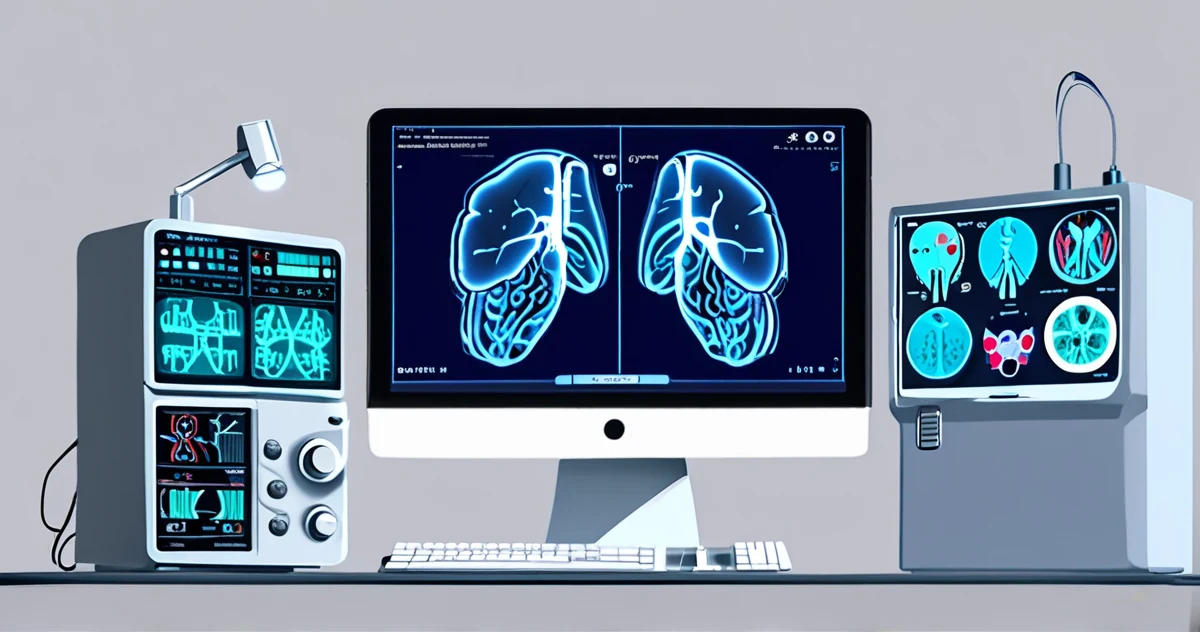
A radiologist examines a series of lung images, his eyes tired after eight hours of work. Beside him, an AI system discreetly flags an anomaly he had missed: a barely visible 4 mm lesion. This scenario is no longer science fiction but a daily reality in some French hospitals. The arrival of artificial intelligence in medical diagnosis is not limited to replacing tasks—it fundamentally redefines what it means to be a healthcare professional in the 21st century.
Anxiety about automation, often called "automation anxiety," particularly affects the medical sector where human expertise has always been considered irreplaceable. Yet, according to a Pew Research Center study, the majority of experts surveyed believe that AI-driven automated systems are already improving many aspects of healthcare. This tension between improvement and replacement lies at the heart of the current debate.
This article explores how AI is concretely transforming medical diagnosis, analyzes the legitimate concerns of professionals, and examines how doctors and algorithms can evolve together rather than against each other.
AI as a Diagnostic Assistant: Between Promises and Current Limits
Diagnostic support systems represent the most visible application of AI in medicine. Designed to help healthcare professionals accurately diagnose medical conditions, these systems often analyze complex medical data, as highlighted by research published in ScienceDirect. Medical imaging is the preferred application area: radiology, dermatology, ophthalmology.
Yet, AI remains at an early stage of its full use for medical diagnosis. As noted in a study in BMC Medical Education, more data is emerging for AI application in medicine, but its full integration still requires time and rigorous validation. Current systems function better as "second opinions" than as autonomous diagnosticians.
Documented benefits include:
- Detection of subtle patterns invisible to the human eye
- Faster analysis of large volumes of images
- Reduction of errors due to fatigue or distraction
- Standardization of certain aspects of diagnosis
Professional Anxiety: Fear of Obsolescence or Opportunity for Evolution?
"I wonder if my years of training and expertise will be devalued by AI"—this question, drawn from a study published in SAGE Open Nursing, summarizes the central concern of many healthcare professionals. Anxiety about job displacement is not only economic but also identity-related: what remains of the doctor if an algorithm can diagnose better?
Healthcare workers participating in this study expressed moral concerns about the replacement of medical professionals by AI. This concern fits into a broader context where burnout has become so pervasive among doctors, nurses, and caregivers that it now significantly harms the healthcare workforce, as documented by research in the Journal of Medical Internet Research.
Yet, this anxiety might be misplaced if we consider AI not as a replacement but as a tool to alleviate cognitive load. Imagine a digital stethoscope that doesn't listen instead of the doctor, but amplifies subtle sounds the human ear might miss.
The Transformation of the Medical Role: From Pure Diagnosis to Clinical Synthesis
The arrival of AI does not eliminate the doctor but transforms them. The healthcare professional evolves from a role centered on pure detection toward a function of synthesis and contextual interpretation. The algorithm can identify an anomaly, but only the doctor can:
- Integrate this information with the patient's history
- Consider psychosocial aspects
- Account for patient preferences
- Manage uncertainty and borderline cases
This evolution resembles that of the airplane pilot with cockpit automation: fewer manual tasks, more supervision, complex decision-making, and management of exceptional situations.
Ethical principles recognize the growing role AI will play in healthcare in the future, as noted in a report from the National Center for Biotechnology Information. These principles emphasize the need to maintain human supervision and the ultimate responsibility of the healthcare professional.
Ethical and Regulatory Challenges: Who is Responsible When AI Makes a Mistake?
Ethical and regulatory challenges of AI technologies in healthcare constitute a major obstacle to their widespread adoption. An analysis in ScienceDirect identifies several crucial questions:
- Liability in case of diagnostic error
- Algorithm transparency (the "black box" problem)
- Potential biases in training data
- Patient data protection
- System certification and validation
These challenges are not purely technical but require broader societal reflection on the place of technology in decisions as intimate as health.
Toward Human-Machine Collaboration: The "Second Opinion" Intelligent Model
The most promising model is not one of replacement but of collaboration. AI functions as a virtual colleague that:
- Performs initial data triage
- Flags cases requiring particular attention
- Proposes diagnostic hypotheses
- Continuously updates its knowledge
The doctor retains their role as final decision-maker but benefits from enhanced analytical capacity. This approach aligns with the conclusions of a Nature study that emphasizes the critical role of AI in healthcare, both in diagnosis and beyond, while maintaining the importance of human integration.
Impact on Medical Training: Learning to Work with AI
Medical training must evolve to prepare future professionals for this new reality. Necessary skills now include:
- Digital and algorithmic literacy
- The ability to critically evaluate AI suggestions
- Integration of technical data with clinical intuition
- Communication of AI-assisted results to patients
A silent revolution is underway in medical schools, where teaching collaboration with intelligent systems is beginning to infiltrate the traditional curriculum.
Conclusion: Toward Augmented Rather Than Replaced Medicine
Artificial intelligence in medical diagnosis does not represent an existential threat to the medical profession, but rather a profound transformation of its nature. As anticipated by Pew Research Center experts, AI-driven automated systems are already improving many aspects of care, but this improvement crucially depends on how humans and AI evolve together.
Anxiety about automation is understandable but could be counterproductive if it prevents embracing the real opportunities of AI to:
- Reduce the cognitive load on professionals
- Improve diagnostic accuracy
- Free up time for patient relationships
- Detect diseases earlier
The question is no longer whether AI will transform medicine, but how we can guide this transformation to serve both professionals and patients. In ten years, will we look back and wonder how we could practice medicine without these tools, as we marvel today at medicine without modern imaging?
To Go Further
- Pew Research Center - Prospective analysis on human-AI co-evolution
- PMC - The Role of AI in Hospitals and Clinics - Study on healthcare transformation by AI
- Springer - Revolutionizing healthcare - Role of AI in clinical practice
- PMC - Balancing act - AI facing healthcare burnout
- ScienceDirect - Ethical challenges of AI - Ethical challenges of AI technologies in health
- SAGE Open Nursing - Study on caregiver concerns about AI
- NCBI - Chatbots in Health Care - Principles for AI in health
- Nature - AI in the COVID-19 pandemic - Case study on the role of AI in health